

8 min read · Updated Oct 4, 2026
Pick a full-size Rider-Waite-Smith deck with illustrated Minor Arcana and a guide you can actually read.
Clear pictures and comfortable cards matter more than fancy packaging or promises about accuracy.
You do not need someone to gift you a deck, bless it, or approve it spiritually before you start studying. The images help you interpret. They cannot predict your life.
Why begin with a Rider-Waite-Smith style deck?
Illustrated scenes give you something concrete to describe. A figure carrying many wands suggests a different starting point than a list of keywords alone.
Because lessons and references in this system use the same images, you spend less time translating between your deck and your study material.
The Learn With Lavanya course uses this system as its default. The specific publisher recommendation arrives in the welcome information after acceptance.
What follows is an editorial shortlist based on publisher descriptions and teaching compatibility.
Nobody hands-tested every deck available in India, and this is not a ranking. There are no affiliate links.
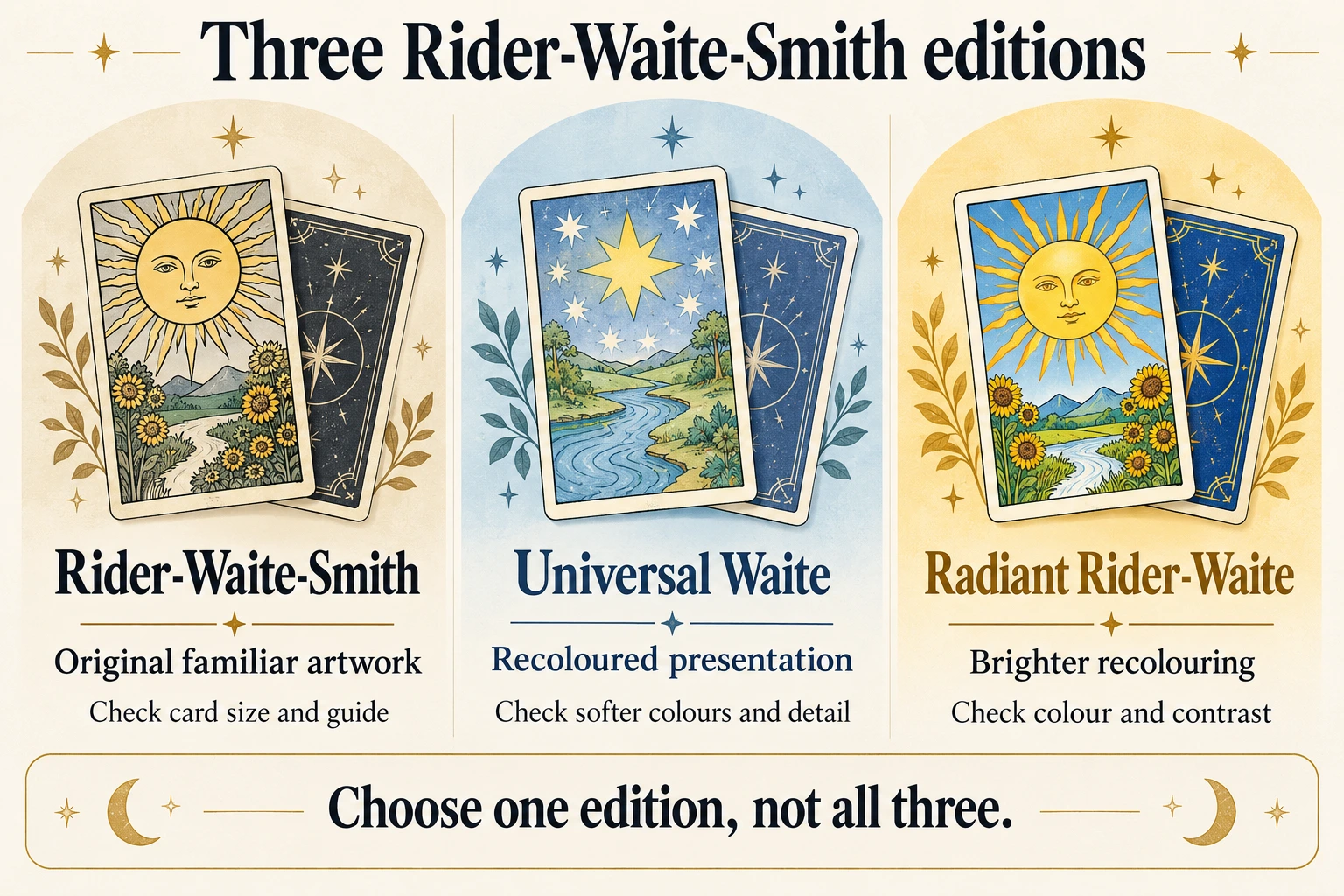
Three editions to compare
| Deck | Published distinction | What to compare before buying |
|---|---|---|
| Rider-Waite-Smith Tarot | Familiar artwork credited to Pamela Colman Smith, with A. E. Waite | Card size, guide language and the exact edition |
| Universal Waite Tarot | A recoloured presentation of the familiar artwork | Whether you find its colours and details easy to read |
| Radiant Rider-Waite Tarot | A brighter recolouring of the Rider-Waite imagery | Whether the stronger colours suit your eyes and study setup |
Check the publisher’s pages for Rider-Waite-Smith, Universal Waite and Radiant Rider-Waite.
What should you inspect before ordering?
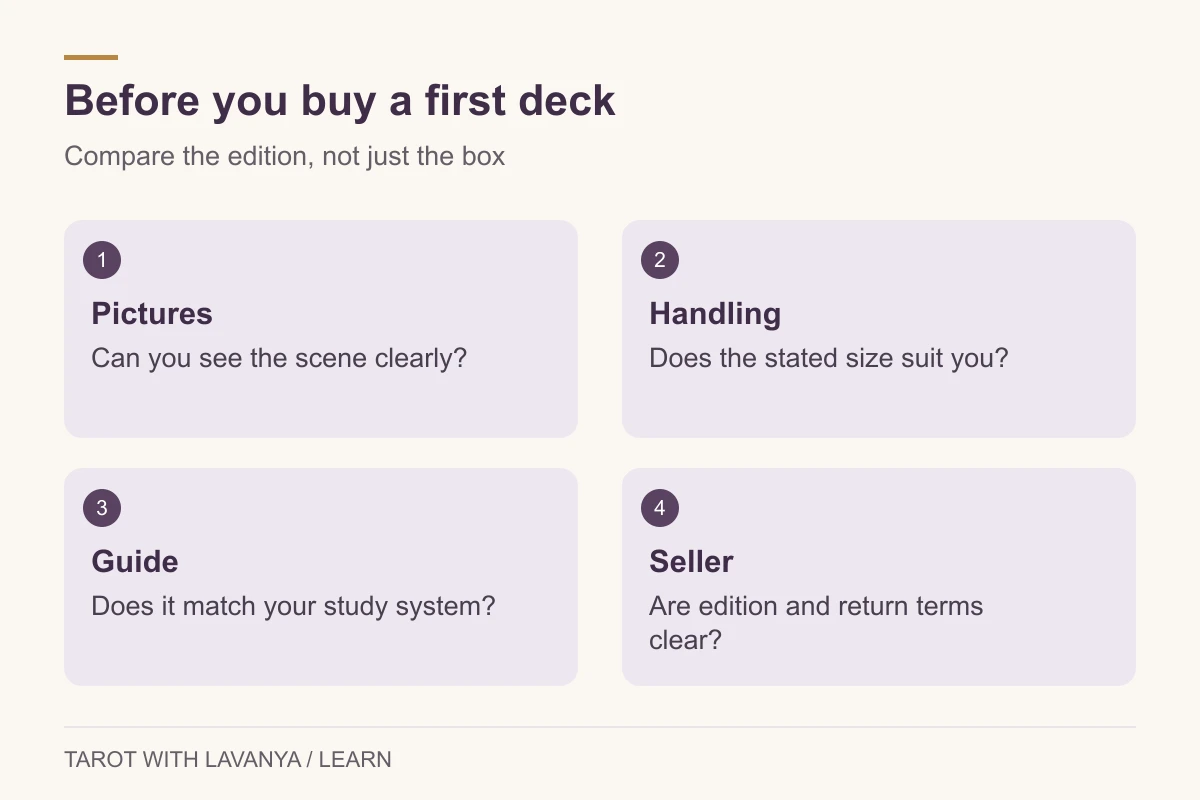
Compare the edition, not just the box.
The box photograph tells you almost nothing. Ask for card dimensions, sample images, the card count, guide language, and publisher details.
The Minor Arcana pictures
Pull up a numbered card. The Three of Swords or Six of Cups works well. A detailed scene gives a beginner more visible material to discuss.
Some other tarot traditions arrange suit symbols instead of scenes. Those decks are studyable, but a Rider-Waite-Smith lesson may not map directly onto their images.
Size and readability
Pocket decks fit in a bag. Smaller print and pictures can be harder to study, though. A large deck is easier to see but awkward to shuffle.
Check the actual dimensions rather than trusting labels like “standard” or “mini.” If shuffling feels difficult, mix the cards on a clean table.
Guide and edition
Find out whether a guidebook comes with the deck and which language it uses.
A QR code, a short leaflet, and a printed book are different things.
A cheap edition is not automatically unsuitable. An expensive listing does not prove authenticity.
Compare the seller’s details against the named publisher. Examine the return policy.
How much should a beginner spend in India?
Set a budget you are comfortable with. Then compare the same edition across reliable sellers. Imported editions, local stock, shipping, and different formats produce different prices.
This guide does not give an unverified rupee price range or promise stock availability.
Check the final amount, seller, and exact edition on the day you buy.
Avoid buying several decks before you have used one.
If you already own a clear deck that matches your lessons, your next useful purchase may be no purchase at all.
Tarot, oracle, Marseille and Thoth are different choices
An oracle deck can use its own number of cards and structure.
It does not automatically teach the 78-card tarot system.
Marseille and Thoth decks belong to different traditions from Rider-Waite-Smith.
They deserve learning resources that explain their own images and conventions.
A themed deck may preserve the familiar structure or change it considerably.
Check several sample cards before you assume a beginner course will explain every image.
If you love a particular deck, that can make practice enjoyable. Still, decide consciously whether you want to learn its distinct system or follow a course built on another one.
Try the picture test
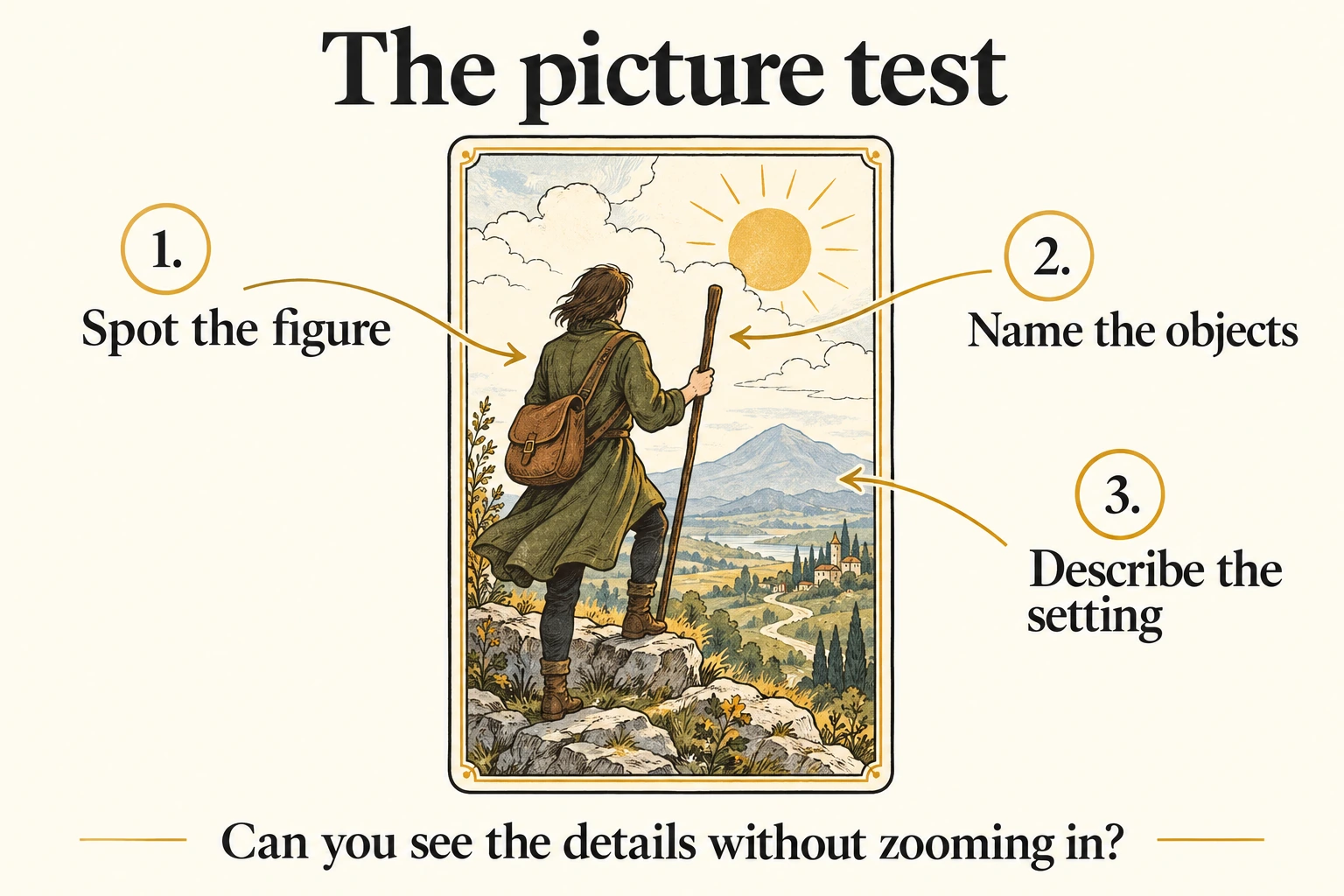
Before choosing, look at a sample of the Fool. Describe what you see. Can you distinguish the figure, the landscape, and the objects without enlarging the image repeatedly?
Then compare it with the Fool card guide. You do not need to agree with every interpretation. You need to see the details being discussed.
Repeat with the Hermit. If the pictures are clear to you and compatible with your lessons, you have a practical starting point.
Common questions about a first tarot deck
Must your first deck be a gift?
No. You can buy your own deck and begin studying it. Receiving a gift is a personal tradition, not a requirement for reading pictures and learning the system.
Do you need to buy cleansing products?
No. You do not need a purchasable remedy or ritual item to study tarot. Keep your deck in a condition that lets you use it comfortably.
Are cards with printed meanings helpful?
They may help you recall vocabulary, but they can also draw your eye away from the image. Check whether the text is readable and whether it leaves enough room to observe.
Can you learn with a deck you already own?
Yes, if you can identify its system and find suitable learning material. If your class uses Rider-Waite-Smith, ask the teacher whether your deck will work with its examples.
How can you compare two decks without buying both?
Use the same small set of sample cards for each edition. Compare a Major Arcana card, a numbered Minor Arcana card, and a court card. That shows more than judging a box design or one favourite illustration.
Ask whether you can identify the figures and objects easily. Notice the contrast between the main subject and background. Check whether the card title stays readable at the actual printed size.
Phone photographs can make colours look brighter or hide fine detail.Look for several clear publisher images and stated dimensions.
If the listing provides neither, ask for more information before ordering.
The Magician guide works for a comparison exercise. Can you see the objects the explanation discusses?
If your edition changes them, do you have a guide that explains its choices?
This is a compatibility test, not a test of the deck’s power.
You are choosing a visual learning tool that you can use comfortably.
What should you check when the deck arrives?
Check the cards against the publisher’s description while the seller’s return window is still open.
Confirm the count, edition, and any included guide. Inspect for missing, duplicated, or badly printed cards.
Try handling the deck on a clean surface. You do not need an elaborate shuffle.
Divide it into small piles or mix it gently on the table if that works better for your hands.
Then choose three cards and compare them with your study material.
Check whether the names and images are easy to match. Keep packaging until you have resolved any problem with the order.
| Check | What you are looking for |
|---|---|
| Completeness | The advertised cards and included materials are present |
| Details and titles are readable without major defects | |
| Handling | You can mix and draw without discomfort |
| Lesson fit | Your reference explains the deck’s system |
| Seller support | You know how to report a missing or damaged item |
None of these checks requires a special ritual.
They help you identify an ordinary product problem before confusing it with a learning difficulty.
When does a second deck make sense?
A second deck can be useful when you have a clear reason for it. You might need larger images for study, a more portable edition, or resources for a different tradition.
If you simply feel stuck interpreting the first deck, pause before buying another.
Try a smaller spread, a clearer question, or feedback on your reasoning. New artwork may be enjoyable without solving that particular problem.
Practise with the question-framing guide and one familiar card.
If the answer becomes clearer when the question improves, the deck was probably not the immediate obstacle.
Choose your next purchase around a practical need you can name.
One deck you understand and use regularly is a sound foundation for further study.
How do you care for a study deck?
Store it somewhere dry and clean, away from spills or conditions that could warp the cards.
Follow any care instructions supplied with the edition. Ordinary protection is enough to keep a learning tool usable.
Avoid writing meanings directly onto the cards until you know that is a choice you want to keep. A separate notebook lets your understanding change without covering details in the picture.
If a card becomes damaged or missing, contact the seller or publisher about available options.
Do not assume that a damaged card has a special message or requires another spiritual purchase.
Keep the guide with the deck so you can identify its system and edition later.
This is especially useful when comparing a lesson with artwork that uses different names or symbols.
Put the deck to use
This week, choose one card and write five observations before opening the guidebook. Then practise with the one-card reading guide.
If you want help connecting the pictures into a reading, explore the live course and its practice structure. A useful deck supports that work; it does not do it for you.
About Lavanya Arora
This week, choose one card and write five observations before opening the guidebook. Then practise with the one-card reading guide.
If you want help connecting the pictures into a reading, explore the live course and its practice structure. A useful deck supports that work. It does not do it for you.
About Lavanya Arora
I am Lavanya Arora, a certified tarot reader and Chaldean numerologist based in Gurugram, Haryana.
I have given over 4,000 paid sessions since 2019, hold 200+ verified five-star Google reviews, and was named Best Tarot Reader in India at the 2025 GHP Mental Health Awards.