

16 min read · Updated Oct 4, 2026
Quick summary: Building a tarot reading business requires setting firm boundaries and honing your card skills first.
Then pick one service, attach a clear price to it, and set up a booking flow that works. Test whether anyone actually wants it before you spend heavily.
Tarot cannot guarantee a client’s outcome, and a business course cannot guarantee your income. The plan below is an operating checklist, not legal, tax or financial advice. Consult a qualified accountant or lawyer about requirements for your circumstances.
In this article
- Do you have what it takes to charge for readings?
- Launch with a single, well-defined offering
- What is the right way to price your initial sessions?
- Create a scheduling flow users can actually complete
- Which platforms will drive your earliest leads?
- Which metrics deserve your focus?
- A realistic schedule for your opening thirty days
- Frequent operational inquiries
- Which details must your initial landing page include?
- How do you map out availability without guessing your sales?
- Which promotional platform deserves your initial focus?
- What is the best way to manage messages and check-ins?
- Which data points actually drive commercial growth?
- How do you troubleshoot an empty appointment book?
- Which checks must precede your first ad campaign?
- What is the ethical way to gather testimonials?
- Which assets must exist after thirty days?
- How do you navigate the opening five minutes?
- Which metrics belong in your weekly audit?
- Which expenses can you safely delay?
- Pick your immediate action step
Are you ready to offer a paid Tarot reading?
Knowing card definitions is not the same as being ready. You need to explain an interpretation clearly, manage session time, and recognise when a question sits outside your scope.
Practise on consenting adults who understand you are still learning. Ask them whether your explanation was clear, whether you listened, and whether you actually answered their question. Agreement with your interpretation does not prove prediction accuracy.
Write your boundaries using the ethical responsibilities guide. A reading should not replace medical care, therapy, legal advice or regulated financial advice.
If declining a question feels uncomfortable, rehearse that conversation before you accept payment. “That needs a qualified professional” is a complete and useful boundary.
Launch with a single, well-defined offering
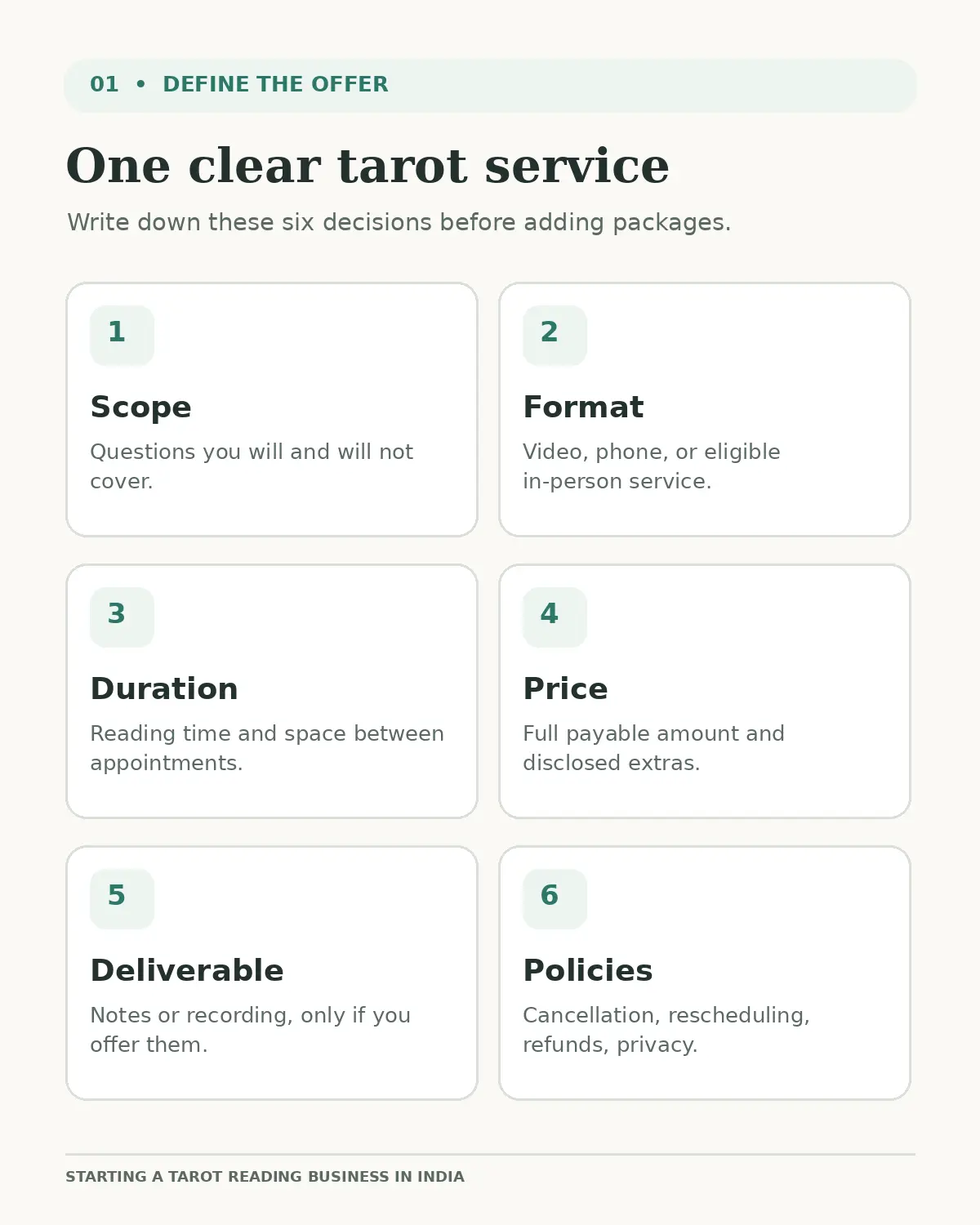
A small menu is easier to explain and deliver. Spell out who the session is for, how long it runs, what format it takes, and what it covers. State whether the client gets anything afterwards.
You might design a fixed-length conversation built around one decision. Explain that the reading explores perspectives and possible actions; it does not decide for the client.
This is a service-design example, not a claim about market demand. Check whether people understand it before you build several packages.
| Choice | Document this |
| Focus | Which topics the appointment will and will not cover |
| Medium | Phone, video, or a qualified face-to-face setup |
| Timing | Total minutes plus required breaks between slots |
| Cost | The complete fee alongside any transparent add-ons |
| Output | If the buyer gets an audio file or written summary |
| Rules | Privacy, refunds, date changes, and cancellations |
Do not add remedies or frightening explanations to make the service appear more valuable. Clarity, respectful listening and a well-run session are work in their own right.
What is the right way to price your initial sessions?
Add up the full time involved: preparation, the session itself, administration and any follow-up. Factor in the costs of delivering the service when you decide whether a price holds up.
Keep forecasts separate from actual bookings. A hypothetical fee multiplied by available slots is possible revenue, not an earnings forecast. Available hours do not tell you how many people will pay.
Track completed sessions, money received, refunds, direct costs and time spent in a simple record. Review it with an accountant where appropriate.
And avoid promising a permanent low price before you understand the workload. If you introduce a practice rate, explain the learning stage honestly and specify what the client receives.
Build a booking process people can finish
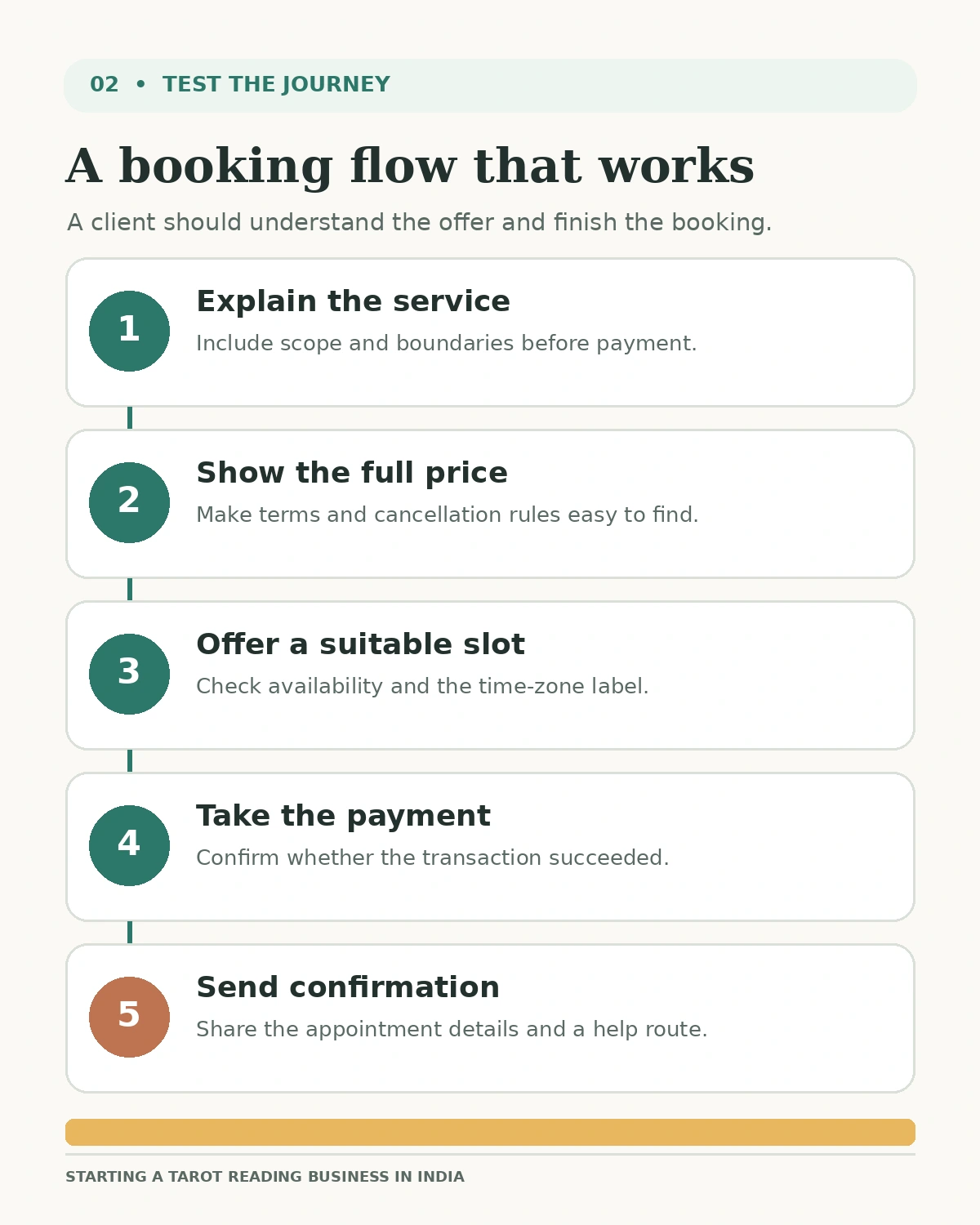
A person should be able to understand the service, see its price, pick a suitable slot and get confirmation. They should not need several private messages just to discover basic terms.
Before you accept bookings, walk through the process as a customer would. Check time zones, payment confirmation, cancellation instructions and the contact route when something fails.
Collect only the information you need for the session. Explain how you handle notes and recordings. Obtain permission before recording, and do not turn private conversations into marketing material.
Which platforms will drive your earliest leads?
Pick a channel you can actually maintain. A clear website page, useful teaching posts or relevant community participation can each help people understand your approach.
Show how you frame a question or explain a card. A worked example labelled as an example is more informative than a claim that every reading is accurate.
The question-framing guide works as a model for making boundaries visible. People should know what kind of conversation they are booking.
Ask willing clients for honest reviews without scripting their praise. Request separate permission for any public quotation. A private thank-you message is not automatic permission to publish it.
Check eligibility before creating a Google Business Profile
Google’s rules require eligible businesses to make in-person contact with customers during stated hours. Online-only businesses are not eligible under its published guidance.
If you plan a local practice, check the current Google Business Profile eligibility rules. Do not invent an office, address or service area to obtain a listing.
Which metrics deserve your focus?
Tackle the very first bottleneck in your funnel.
Follow the steps between discovery and a completed reading. That makes it easier to spot the next useful change.
| Indicator | Area to examine |
| Low landing page traffic | If your target market can actually locate you |
| Traffic but zero messages | If your fees, limits, and credibility are obvious |
| Messages but zero sales | Confusing checkout steps, calendar clashes, or lingering doubts |
| Sales but high drop-offs | Unclear rules, weak reminders, or mismatched expectations |
These are diagnostic questions, not guaranteed explanations. Speak with people who enquired, where they have agreed to follow-up, rather than guessing their reasons.
A realistic First Month Plan
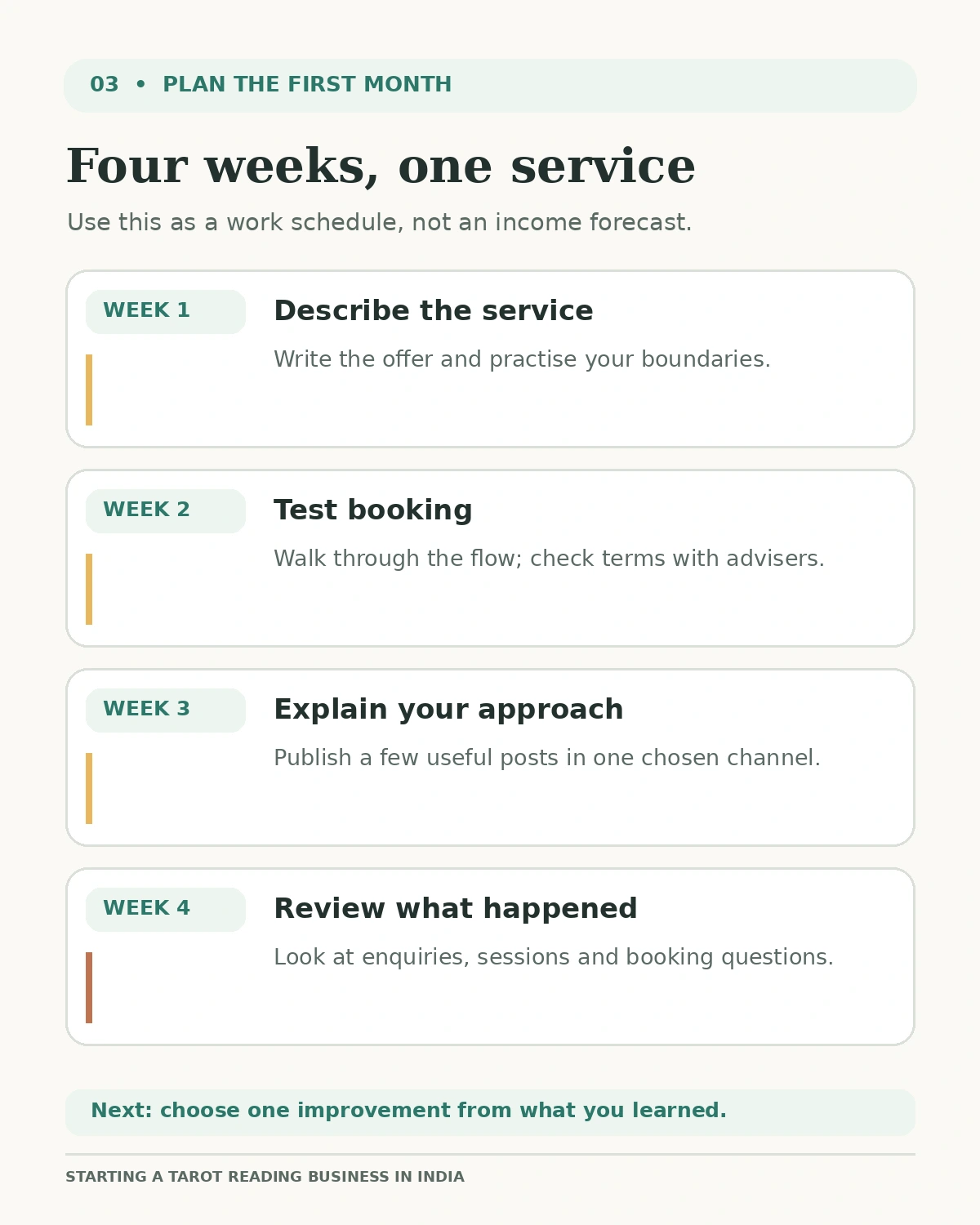
Week one: write your service description and practise your boundaries.
Week two: test the booking flow and check your terms with appropriate advisers.
Week three: publish a few useful explanations through one chosen channel.
Week four: review enquiries, completed sessions and the questions people asked before booking.
This is a suggested work schedule, not a promise that you will have clients within a month. If demand is weak, investigate the offer before buying more tools or advertising.
Frequent operational inquiries
Will a tarot certification make you a qualified entrepreneur?
Diplomas only reflect the curriculum of the school that printed them. They fail to cover your legal duties or guarantee you can run a valuable commercial appointment. Evaluate your commercial and educational needs entirely apart from one another.
Is it possible to launch this while employed full-time?
Restricting your calendar works fine as long as it respects your primary employment. Always factor in backend admin and prep work instead of just tallying the minutes spent on the actual call.
Which commercial tools does Learn With Lavanya provide?
Their elective Business Center teaches profile optimization, local directory management, and guided Google setup for qualifying students. This module operates independently from the Foundation Cohort and includes zero financial promises.
What details belongs on your first service page?
Write the page around the decision a prospective client needs to make. They need to understand the service, judge whether it suits their question and know what happens after booking.
Open with one plain sentence describing the conversation. Follow it with the duration, format, full payable price and booking steps. Explain any limits before the payment button, where a person can use them to decide.
A fictional example might read: “A 30-minute online conversation to explore one personal decision through tarot. You choose the question, discuss possible perspectives and leave with a practical next step.”
That example is a service-description exercise, not a recommended package or evidence of demand. Adapt the scope to what you can deliver consistently. Do not promise a written report if you have not allowed time to prepare it.
Your page should also explain how to contact you about a booking problem. A person whose payment succeeded but confirmation failed needs a clear route for help. They should not have to post private details in a public comment.
Outline the actual appointment flow
Describe the sequence briefly: clarify the question, agree the scope, discuss the cards and finish with a recap. This helps someone who has never booked a reading understand the experience.
Use an invented scenario clearly labelled as a teaching example. The one-card reading page can help you explain the difference between a card prompt and a personal conversation.
Avoid presenting a free automated draw as though it were an individual reading. State which parts use preset text and which involve your time. Clear expectations reduce confusion before the session begins
Integrate your limits directly into the pitch
Do not hide exclusions in a long policy document. State the important ones near the service description, then link to fuller terms where necessary.
For instance, a reading does not diagnose illness, establish another person’s private thoughts or guarantee a fixed date. A person seeking those answers should understand the limit before paying.
Write a courteous response for unsuitable enquiries. You can say: “That question needs evidence or professional advice I cannot provide through tarot.” You do not need to sell an alternative service in every such conversation.
How do you map out availability without guessing your sales?
Count the whole appointment cycle. A 30-minute reading might also require preparation, confirmation, a buffer and administration. Use your own measured time rather than borrowing someone else’s estimate.
Here is a fictional planning exercise. Suppose you reserve three hours on a Saturday. If each appointment needs a 30-minute session and a 15-minute buffer, the block holds four appointments.
That is capacity, not a booking forecast. You could receive zero enquiries, one booking or more requests than you can accept. Keep those possibilities separate from the number of slots on your calendar.
After practice sessions, record how long the supporting work actually takes. If the buffer is too short, reduce availability or change the process. Do not promise a timetable that requires every session to run perfectly.
But also leave space for cancellations, rescheduling and technical problems. A simple policy helps, but it cannot eliminate ordinary interruptions. A smaller schedule you can maintain is easier to assess than an ambitious one you keep changing..
Which promotional platform deserves your initial focus?
Choose the channel where you can demonstrate your approach clearly and respond consistently. The right starting point depends on your existing audience and the type of service you offer.
If people already ask you about tarot on Instagram, answer common questions through useful posts and a clear service link. If you already have a website, improve the main service page before adding many unrelated articles.
If you participate in a community, follow its rules and contribute without turning every conversation into a pitch. Only share a booking link where it is welcome and relevant.
A local in-person practice may have different discovery options from an online-only service. Check eligibility before creating local listings. Being available by video does not by itself make a business eligible for Google Business Profile.
Assign a single goal to every update
A beginner may need help choosing a question. Another person may wonder what happens during a session. A third may want to know how you handle uncertainty. Those are different posts.
An educational example could use the Justice card guide to discuss checking facts and considering consequences. Avoid turning the card into a promise about a court case or another legal outcome.
End with a relevant next step. A post explaining your service can point to its booking page. A basic card lesson may simply point to another lesson. Every piece does not need an immediate sales request.
Draft a brief content roadmap
Try four connected subjects: what a session covers, how to ask a useful question, a labelled example interpretation, and how booking works. Together they answer common uncertainties without requiring a large publishing schedule.
Use the same clear description of your service throughout. If one post promises prediction and the service page promises reflection, the audience receives conflicting expectations.
Review the actual questions people ask after seeing the content. Their wording can reveal a missing explanation. It does not automatically prove that you need another channel or more advertising.
How should you handle enquiries and follow-up?
Reply with enough information for the person to decide. Confirm the service scope, price, available format and next step. If their question is outside your boundaries, explain that before discussing payment.
Keep a short set of answers for recurring practical questions. These might cover session length, time zones, recording, rescheduling and what to prepare. Review the answers whenever your offer changes.
If someone asks you to follow up later, record the agreed timing and channel. Do not treat a single enquiry as permission for an ongoing promotional sequence. Make it easy for them to say they are no longer interested.
Avoid pressuring someone by saying the cards require an urgent booking. A reading should remain a voluntary purchase, and a person should be able to decline without fear.
After a completed session, send only the recap or resources you promised. If you invite feedback, ask about the experience and clarity of the conversation. Do not ask a client to confirm that a prediction was accurate to earn a benefit.
Which data points actually drive commercial growth?
You need enough information to understand the booking process without turning private reading content into a marketing database. Keep operational records separate from any session notes.
A simple enquiry log can contain the date, discovery channel, requested service, status and a practical reason for not booking if volunteered. Avoid copying intimate details from the conversation into that log.
For completed appointments, record the date, duration, payment status and follow-up owed. Discuss financial record requirements with a qualified accountant rather than relying on a generic online template.
| Commercial query | Helpful metric | False assumption to drop |
| Where do leads come from? | Their stated origin or a tracked UTM link | Every follower will eventually buy |
| Can they find open slots? | Calendar complaints and abandoned carts | Empty days mean your fee is too high |
| Is the pitch obvious? | Repetitive questions prior to checkout | High traffic guarantees high intent |
| Is your delivery stable? | Real admin minutes and call length | The appointment length equals your total shift |
| Are check-ins scaling? | Due dates for promised files | Free extra support takes zero effort |
These records help you choose a question to investigate. They do not explain every outcome. A person may decline for reasons they prefer not to disclose, and they do not owe you an explanation.
How do you troubleshoot an empty appointment book?
Start with the earliest stage that lacks evidence. If almost nobody reaches the service page, rewriting the refund paragraph is unlikely to solve the immediate discovery problem.
If people visit but cannot describe the offer, improve the explanation. If suitable people enquire but cannot attend, inspect availability. If they report failed payments, repair the booking process before buying more traffic.
Use a single change where possible, then watch the relevant step. Changing the price, headline, schedule and booking system together makes it harder to understand what helped.
There is no universal minimum conversion rate for a new tarot practice. A handful of visits or enquiries can fluctuate sharply. Keep raw counts next to any percentage so the scale remains visible.
A fictional diagnostic example
Imagine two weeks with 80 service-page visits and four enquiries. Two people say the only available slot conflicts with work. One asks a question outside your scope, and one books.
Those numbers are invented to show the method. They do not establish a target rate or expected result. The practical question is whether a suitable alternative time could address the stated scheduling problem.
You could test one additional slot if it fits your capacity. Keep the boundaries unchanged for the unsuitable question. More bookings are not a reason to accept work you cannot responsibly provide.
What should you test before spending on ads?
Test the service page and booking process with a person who has not helped you build them. Ask them to find the price, explain the offer and locate the cancellation terms.
Then test a booking without creating a charge unless you have intentionally arranged one. Check confirmation messages, time-zone labels, reminders and the route for support. Use your payment provider’s authorised test tools where available.
If you later try advertising, define a spending limit and a specific learning question. For example, you might test whether a clearly described offer brings suitable enquiries. Do not interpret clicks as evidence that the business is profitable.
Track confirmed payments and refunds separately from button clicks. Review the total cost of obtaining and delivering appointments before extending a campaign. Obtain qualified financial advice for decisions that depend on your circumstances.
Paid traffic can expose an unclear offer more quickly. It cannot resolve that uncertainty by itself. Fixing a visible booking problem first makes any later experiment easier to interpret.
What is the ethical way to gather testimonials?
Ask for honest feedback about the service a person actually used. Keep a review request separate from any pressure to buy again. A client should be free to leave critical feedback or no review at all.
If you want to quote a private message on your website, obtain specific permission for the wording and attribution. Check whether the person is comfortable being named. Remove identifying details from sensitive situations.
Do not turn a reading review into a course testimonial. The client may have had an excellent session without knowing anything about your teaching. Describe the source of each review accurately.
Respond to public feedback without disclosing private session details. If a booking issue needs discussion, invite the person to use a private support channel. A public response should not reveal the question they brought to you.
What should be ready at the end of your first month?
Aim for a usable set of materials: one service page, clear terms, a tested booking route, a realistic schedule and a small record of enquiries. That is a more useful milestone than an invented income target.
Keep one sample reading explanation that shows your approach without exposing a client. Use the Fool card guide for a simple learning example if you need a starting point.
Review what remains unclear. You might need better reading feedback, a simpler offer, a different availability pattern or more relevant discovery. Choose the next task from that evidence.
A business can develop gradually alongside ongoing study. Continue reviewing your interpretations and boundaries as carefully as you review bookings. The service people receive remains the basis of the practice you are building
How do you navigate the opening five minutes?
Confirm the client’s name, the booked service and the time available. Ask what they want to explore, then restate the question in plain language. Check that your summary matches what they meant.
Explain the relevant limits before drawing. If the question asks for a medical diagnosis, private facts about someone else or certainty about an outcome, clarify what you can and cannot offer.
Do not collect a detailed personal history simply because it might make interpretation easier. Ask only for context needed for the agreed conversation. Let the client decline a question or stop the session under the stated terms.
If you record sessions, obtain the required permission before starting. Explain what will happen to the recording. Do not assume that joining a video call means agreeing to be recorded.
At the end, recap the interpretation and its uncertainty. Confirm any follow-up you have promised and avoid adding a new sales pitch to a sensitive conversation. A clear close respects the agreed service.
Which metrics belong in your weekly audit?
Choose a short, regular review rather than watching every small fluctuation in enquiries. Look at completed appointments, outstanding follow-up, booking problems and the questions people asked before deciding.
Separate work you control from outcomes you cannot guarantee. You can make the service clear, reply within your stated availability and deliver promised notes. You cannot require people to book or agree with an interpretation.
Select one practical improvement for the next week. It might be a clearer time-zone label, a shorter enquiry reply or a better explanation of session scope. Record why you chose it so you can review the effect later.
Keep learning in that review too. Identify one reading skill that needs attention and schedule practice or feedback. Business administration should not replace continued study of the service you offer.
If your available time has changed, update the booking calendar before accepting more work. Consistency means honouring the offer you make, not keeping the same number of appointments regardless of circumstances.
Which expenses can you safely delay?
A large package menu, elaborate branding and several paid subscriptions can wait until you know what your first service requires. Write down the problem each proposed purchase would solve.
If the problem is hypothetical, test the simpler process first. For example, a clear appointment confirmation may solve confusion without adding a complex customer-management system.
Review the tools you already use before adding another one. Check whether you can export essential records and whether the workflow remains understandable when something fails.
A modest setup you can operate reliably is a useful starting point. Review paid tools again when actual bookings reveal a need the simpler setup cannot meet.
Pick your immediate action step
This week, write one complete service description and test whether another person understands it without explanation. If reading skills need work first, review the Foundation Cohort.
If you already want to offer sessions, the same page explains the optional Business Center. Choose support for the problem you actually have.
About Lavanya Arora
I am Lavanya Arora, a certified tarot reader and Chaldean numerologist based in Gurugram, Haryana. I have given over 4,000 paid sessions since 2019, hold 200+ verified five-star Google reviews, and was named Best Tarot Reader in India at the 2025 GHP Mental Health Awards.
Who is Lavanya Arora?
Operating out of Gurugram, Haryana, I work as a certified Chaldean numerologist and tarot reader. My track record includes delivering more than 4,000 paid appointments since 2019, collecting over 200 verified five star Google reviews, and winning Best Tarot Reader in India at the 2025 GHP Mental Health Awards.