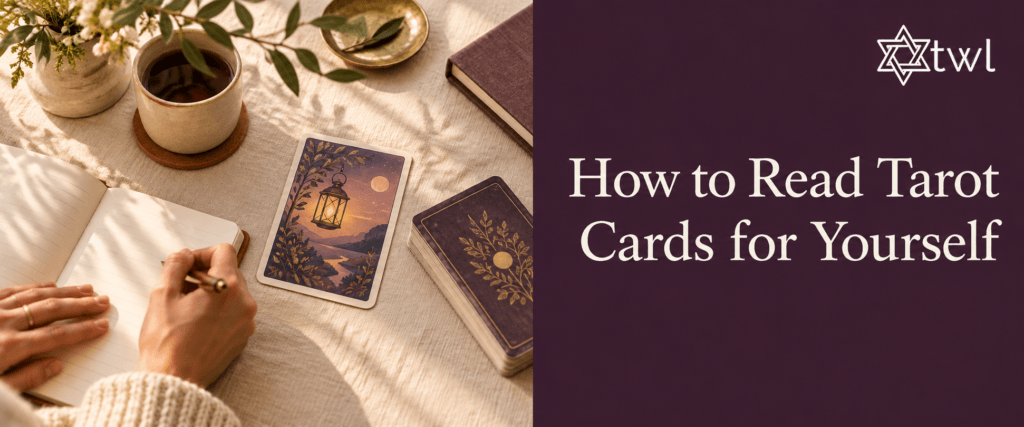
7 min read · Updated Oct 4, 2026
The Short Answer:
Pick one focused question, lay out a small spread, and describe what you see in the images before assigning meaning. Write down your interpretation plus one concrete next step. If the answer upsets you, put the deck away rather than pulling again until it sounds right.
Practise first, then spot where you get stuck
Self-readings work best when you treat the cards as a mirror for your own decisions. Questions about someone else’s private thoughts belong in a direct conversation with that person. Treat every answer as something testable.
What do you need to begin?
A deck, a notebook, and a quiet stretch of time. That is the full list. No special cloth. No gifted deck. Nothing you need to buy for protection.
Pick a deck whose images you can read clearly. Keep the guidebook close, but look at the picture first. Definitions come after observation.
No deck yet? The free yes/no tarot tool gives you an automated draw. It costs nothing and works from preset interpretations. What it cannot do is listen to your context or talk through your reasoning the way a human reader would.
For studying the deck’s larger themes, the Major Arcana hub is a good starting point.
Start with a question you can work with
Write the question down before you shuffle. Aim at your own approach, attention, or choices. Trying to uncover another person’s private intentions leads nowhere useful.
| Instead of asking | Try asking |
|---|---|
| Will everything work out? | What deserves my attention in this situation? |
| What are they secretly thinking? | What am I assuming, and what could I ask directly? |
| Am I guaranteed to succeed? | What preparation am I overlooking? |
| What should I do with my life? | What could I explore through one small action this week? |
Write the question down before you shuffle. Aim at your own approach, attention, or choices. Trying to uncover another person’s private intentions leads nowhere useful.
A one-card reading, step by step
1. Write your question and current assumption
Note what you already expect or want the answer to be. You do not have to remove that preference. Making it visible helps you notice when it shapes your interpretation.
2. Shuffle and draw once
Choose a comfortable way to mix the cards, then draw one. Decide beforehand whether you will use reversals. You can begin with upright cards while learning.
3. Describe the picture
List three visible details: a gesture, an object or a relationship between figures. Keep description separate from interpretation for a moment.
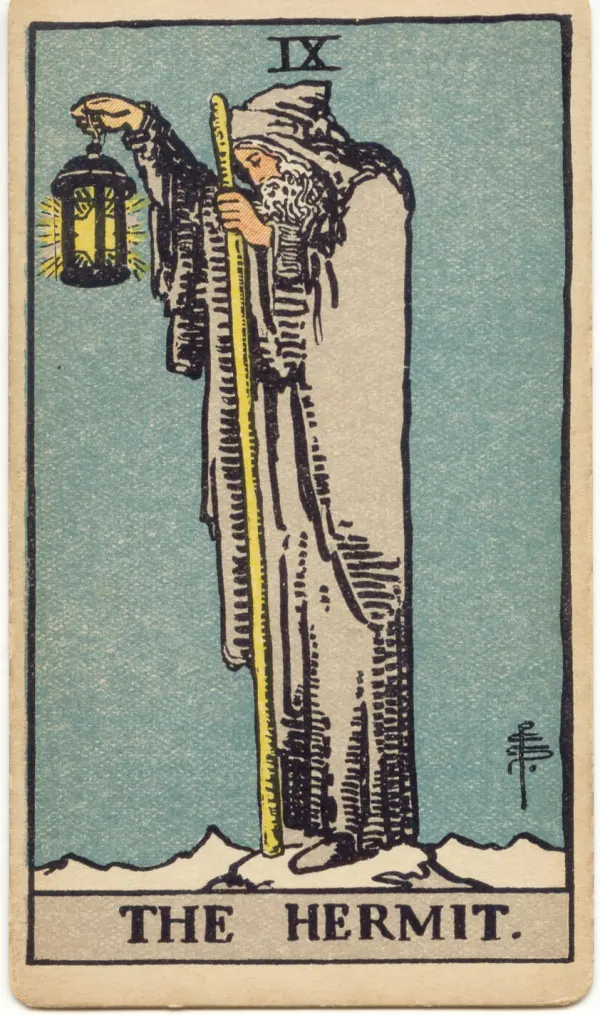
“The figure is holding a lantern” describes the image. “I need time to think” is one possible interpretation. That distinction makes your reasoning easier to review.
4. Connect the image to the question
Offer one possible answer using ordinary language. Explain which detail supports it. Then consider another plausible reading, especially if the first is exactly what you wanted to hear.
Use two sentences: “The image suggests…” for your reading, then “What I actually know is…” for the facts. Notice where an assumption has filled a gap.
5. Check your reference
Read the guidebook or a card guide. Use it to notice something you missed, not to search indefinitely for a reassuring meaning.
6. Finish with an action or observation
Choose something small and reversible: write a question, gather missing information or set aside time to prepare. Then close the reading and return to the situation itself.
Write one sentence about the interpretation and one about what you will do next. Then put the cards away.
A worked example with the Hermit
Suppose your practice question is, “What would help me prepare for a presentation?” Imagine drawing the Hermit. This is a teaching example, not a real client’s reading.
You notice the lantern and a solitary figure. One interpretation is to protect some quiet preparation time. Another is to seek focused guidance from someone experienced.
The card cannot tell you how your audience will respond. It can prompt you to rehearse alone or ask a colleague to review your opening.
Read the Hermit meaning guide and compare its themes with your reasoning. Keep the interpretation connected to the question you actually asked.
When should you try three cards?
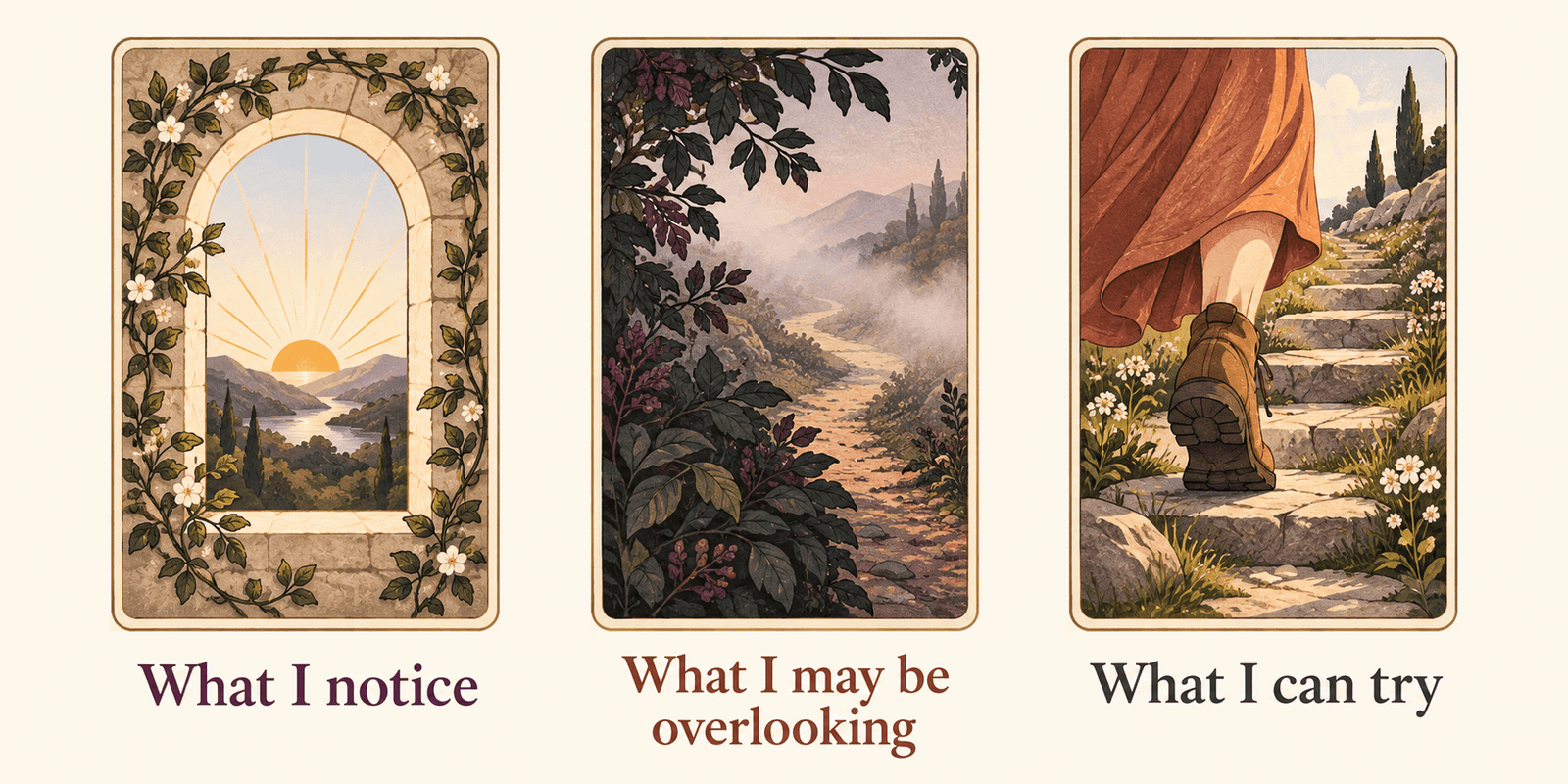
Move to three cards when you can explain one without becoming lost in definitions. Give each position a distinct job before drawing.
Try what I notice / what I may be overlooking / what I can try. Read each card in its position, then write a short answer connecting all three.
The second position does not reveal a hidden fact. It offers a prompt to examine an assumption. Check any concern against actual information before acting on it.
If the spread becomes confusing, return to one card. A larger layout is not automatically a deeper reading.
How do you handle bias when reading for yourself?
Keep the original question and interpretation in your notebook. Write what you hoped to see alongside what the card suggested. Later, compare the entry with what you actually did.
Do not count every broad similarity as a successful prediction. Ask whether the reading helped you identify a question, consider an alternative or take a sensible step.
Want someone to check your reading? Lavanya’s Foundation Cohort is eight weeks of live classes for five learners. Three practice readings receive her written feedback. Applications are reviewed within 48 hours, and nothing is charged until you are accepted.
When is it better to stop?
Pause if you are repeatedly drawing about the same question or feeling more distressed with each card. Put the deck away and return to facts, ordinary support and the conversation you may need to have.
Tarot is not therapy or medical advice. If distress is persistent or disrupting daily life, speak with a qualified mental-health professional. A reading should not delay that support.
For medical, legal or financial decisions, seek the relevant qualified professional. Do not use a card to decide treatment, legal action or an investment.
A journal template you can reuse
Keep the template brief enough that you will actually fill it in. You need to preserve your reasoning, not write an essay after every draw.
- Question: write it before drawing.
- Expectation: note what you hope or fear.
- Observation: describe what you can see.
- Interpretation: offer one reading and an alternative.
- Next step: check a fact or try a small action.
- Later review: record what you learned, dated separately.
Suppose the question concerns preparing for a presentation. Your later review might say that rehearsing exposed an unclear opening. That is useful learning, without proving that the card predicted the audience’s response.
Leave your first entry unchanged. If you revise it, add a dated note instead of rewriting the original. This makes it easier to notice hindsight and selective memory.
When the card does not connect
Start with the image again. Describe a gesture, an object and the space around the figures. Look for one modest connection rather than a dramatic explanation.
If nothing fits, record that honestly. You can consult one reference or leave the exercise unresolved. An unclear reading is not a requirement to draw repeatedly until a story appears.
Common questions about reading your own cards
Is it okay to read tarot for yourself?
Yes, as a reflective practice. You need to be especially willing to question your interpretation because you have a personal stake in the answer.
Do you have to draw every day?
No. Choose a pace that allows you to reflect on what you wrote. A daily draw is an optional study habit, not an obligation.
What if you draw a frightening card?
Do not treat it as a verdict or evidence of danger. Read the image in context and consider its symbolic themes. You do not need to buy a remedy.
What should go in a tarot journal?
Record the date, question, cards, observations, interpretation, alternative reading and next step. Leave space for a later review without changing your original entry.
Practise, then identify what you need help with
This week, complete three short readings using the same method. Review where you get stuck: describing the picture, connecting it to a question or explaining the answer.
The free one-card draw is another way to practise. It is automated and uses preset meanings.
If you want Lavanya to teach you live and check your readings, see the Foundation Cohort curriculum and apply. The application takes about two minutes, and payment is taken only after acceptance.
About Lavanya Arora
I am Lavanya Arora, a certified tarot reader and Chaldean numerologist based in Gurugram, Haryana. I have given over 4,000 paid sessions since 2019, hold 200+ verified five-star Google reviews, and was named Best Tarot Reader in India at the 2025 GHP Mental Health Awards.