13 min read
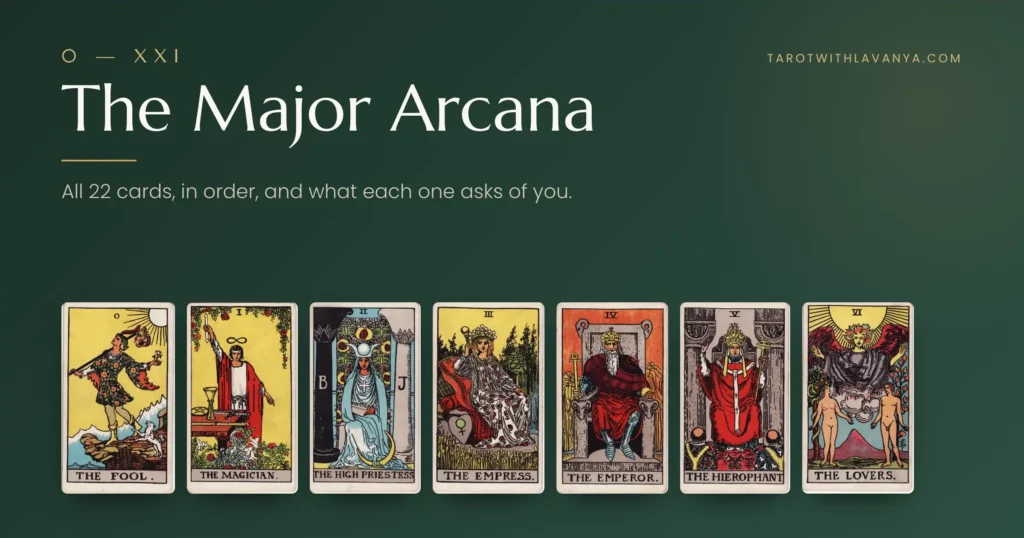
The major arcana are the 22 named cards in a tarot deck, numbered 0 to XXI, and they describe the large moves in a life rather than the daily ones. The other 56 cards, the minor arcana, handle the ordinary week. When a major turns up, the question on the table is bigger than it looked.
The short answer. There are 22 major arcana cards, running from the Fool at 0 to the World at XXI. Read in order they form one sequence, often called the Fool’s Journey. Each card carries an upright and a reversed reading, and each one describes a situation rather than predicting an event. They are the 22 cards most people mean when they say a reading “felt heavy”.
What the major arcana cannot tell you
I want the limit on the table before the list, because these 22 cards get treated as verdicts more than any others in the deck.
They cannot tell you when. Not the month, not the season. Timing is the weakest thing tarot does and I would rather say so than invent a date for you.
They cannot tell you what somebody else will do. A card describes a situation and your position in it. Another adult remains another adult.
They also cannot tell you whether something is a good idea. A card can describe what you are standing in and what it is likely to cost. Whether you want to pay that is a judgement it never makes for you.
And a major arcana card is not a bigger card in the sense of being a better or worse omen. It is a card about a larger question. Death is not worse news than the Three of Swords; it is news about a different scale of thing.
What they are good at is naming the actual question. Most people arrive with a version of their problem they have already tidied up, and a major tends to point at the untidy one underneath.
That is worth saying plainly because of how these cards get sold. A major arcana card is a prompt to look at something. It is not a mechanism, and nothing about drawing one causes an event.
What is the major arcana?
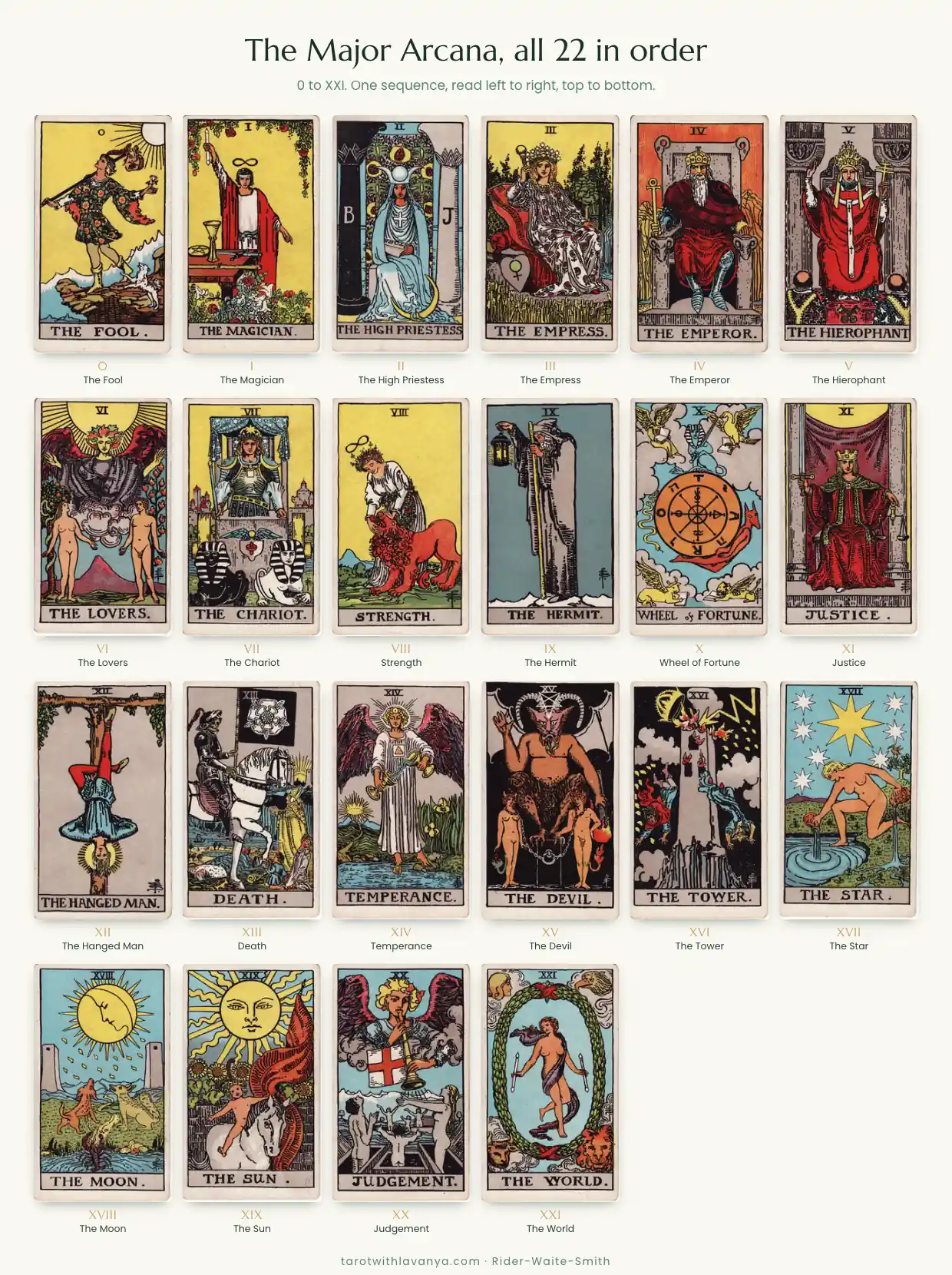
A standard tarot deck holds 78 cards. Twenty-two of them are the major arcana, sometimes called the trumps, and they are the only cards with names rather than suits.
They are numbered, and the numbering matters. The order is not decorative. Read from 0 to XXI it tells one continuous story, which is why learning them in sequence works better than learning them alphabetically.
The word arcana simply means secrets, from the Latin. Major and minor here mean greater and lesser, and they refer to the scale of what the card describes rather than to how much power it holds.
Every card here has an upright and a reversed reading. On this site each of the 22 has its own full page covering both, in love, career, money and health.
One point of confusion worth clearing early. Strength is VIII and Justice is XI in most modern decks, and the two are swapped in older Marseille ones. If your deck disagrees with this page, neither is misprinted.
A. E. Waite made that swap for the 1909 deck so the sequence lined up with Leo, and almost every modern deck follows him. It is the single most common thing people write in about, and it is not an error in either direction.
The other thing worth knowing early is that the Fool sits outside the numbering as much as inside it. Numbered 0, it is sometimes placed at the start and sometimes at the end. Both readings are defensible and the card is the same either way.
All 22 major arcana cards in order
The full list, with the one-line read I use for each and a link to the full card meaning.
| No. | Card | Upright, in one line | Yes or no |
|---|---|---|---|
| 0 | The Fool | A beginning you cannot see the end of | Yes |
| I | The Magician | You already hold what the job needs | Yes |
| II | The High Priestess | Something is known and not being said | Maybe |
| III | The Empress | Something is growing and needs tending | Yes |
| IV | The Emperor | Structure, and whether yours is holding | Yes |
| V | The Hierophant | A method that already works | Yes |
| VI | The Lovers | A choice you can defend | Yes |
| VII | The Chariot | One direction, held while two things pull | Yes |
| VIII | Strength | Patience over force | Yes |
| IX | The Hermit | Chosen solitude with a purpose | Maybe |
| X | Wheel of Fortune | The turn you did not order | Yes |
| XI | Justice | Cause and effect, with her eyes open | Yes |
| XII | The Hanged Man | A pause you chose | No |
| XIII | Death | An ending already happening | No |
| XIV | Temperance | Proportion, not extremes | Yes |
| XV | The Devil | A trade that still pays you something | No |
| XVI | The Tower | A collapse you outlive | No |
| XVII | The Star | Quiet repair after a hard stretch | Yes |
| XVIII | The Moon | What you cannot verify yet | Maybe |
| XIX | The Sun | A yes already underway | Yes |
| XX | Judgement | A summons, not a sentence | Yes |
| XXI | The World | A cycle genuinely finished | Yes |
The yes or no column matches the free yes/no tarot reading on this site, so the tool and the pages agree with each other.
Treat those one-line reads as a handle, not a definition. Each card carries a reversed meaning as well, and the reversal is rarely the simple opposite. The full page for each card is where that lives.
If you are looking a card up mid-reading, the one-line read is usually enough to keep going. Come back to the full page afterwards, when you are not holding a spread and a person’s attention at the same time.
The Fool’s Journey in four stages
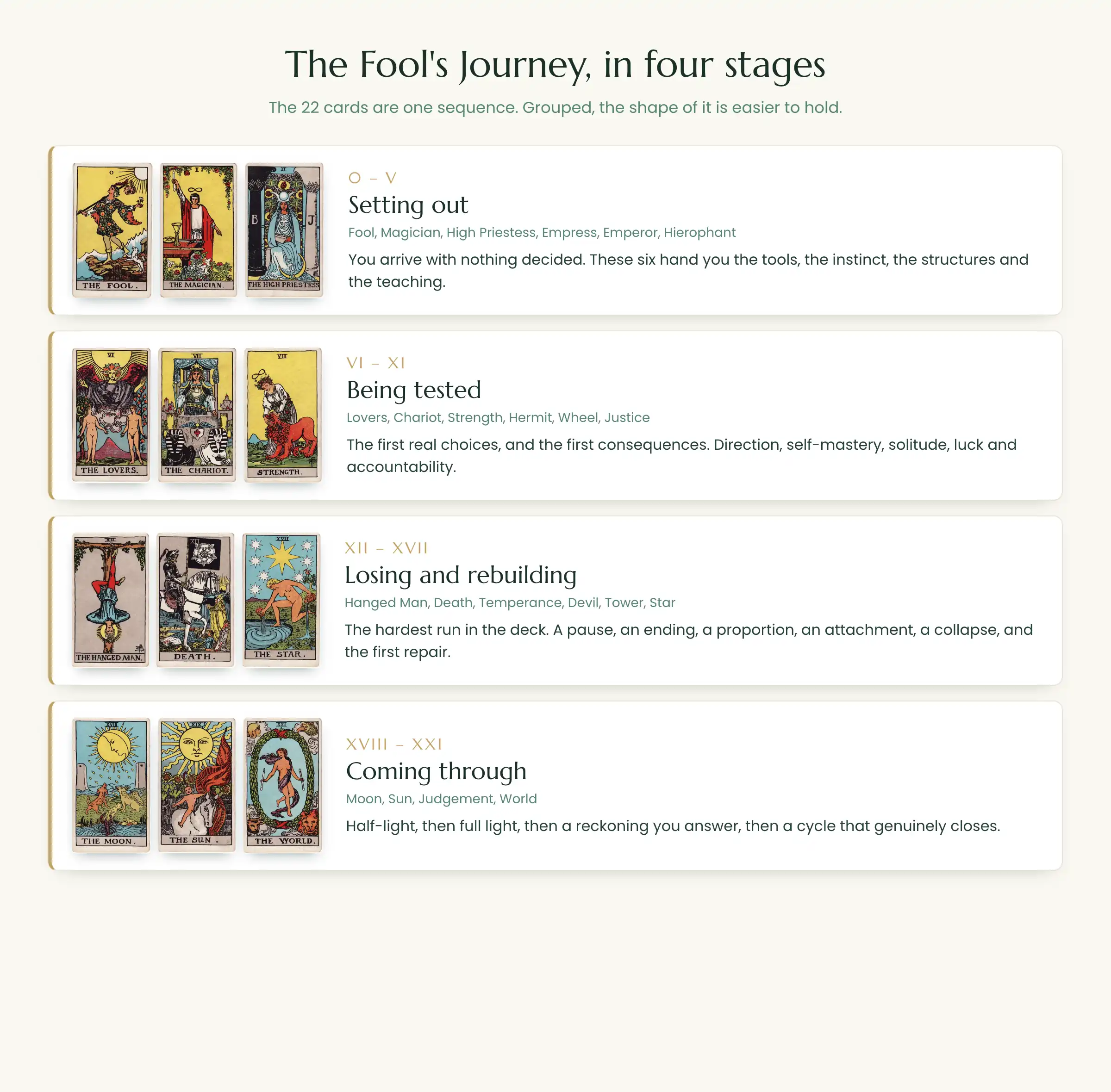
Twenty-two cards is a lot to hold. In four groups it becomes one shape, and the shape is what makes the individual cards stick.
0 to V: setting out
The Fool, the Magician, the High Priestess, the Empress, the Emperor, the Hierophant.
Nothing has been decided yet. These six hand over the equipment: capability, instinct, growth, structure and inherited teaching. Read together they are less a story than an inventory.
If you are learning, this is the easiest group to get wrong, because none of these cards does anything dramatic. They are the conditions you start with rather than events that happen to you.
The pairs matter here too. The Magician and the High Priestess sit next to each other as outward capability and inward knowing, and the Empress and the Emperor as growth and structure. Reading them as pairs is quicker than reading six separate cards.
VI to XI: being tested
The Lovers, the Chariot, Strength, the Hermit, the Wheel, Justice.
The first real choices and the first consequences. A decision, a direction held under pressure, a temper governed, a withdrawal, a turn of luck, and then an account of what all that produced.
Justice closing this run is the part I would notice. The deck puts the accounting immediately after the luck, which reads as a comment on how much of an outcome people credit to circumstance.
XII to XVII: losing and rebuilding
The Hanged Man, Death, Temperance, the Devil, the Tower, the Star.
The hardest run in the deck, and the most useful. A pause, an ending, a proportion, an attachment, a collapse, and the first repair. Read in order it is a fairly exact description of how people actually come apart and reassemble.
Notice that Temperance sits between Death and the Devil. Moderation is offered after the ending and before the attachment, which is exactly the window in which people find it hardest to hold.
XVIII to XXI: coming through
The Moon, the Sun, Judgement, the World.
Half-light, then full light, then a reckoning you answer rather than receive, then a cycle that genuinely closes. The deck never puts these in the other order, and I take that seriously when reading them.
The Moon coming before the Sun is the reassuring part. Uncertainty is placed immediately before clarity in the sequence, not instead of it.
How do you find your major arcana birth card?
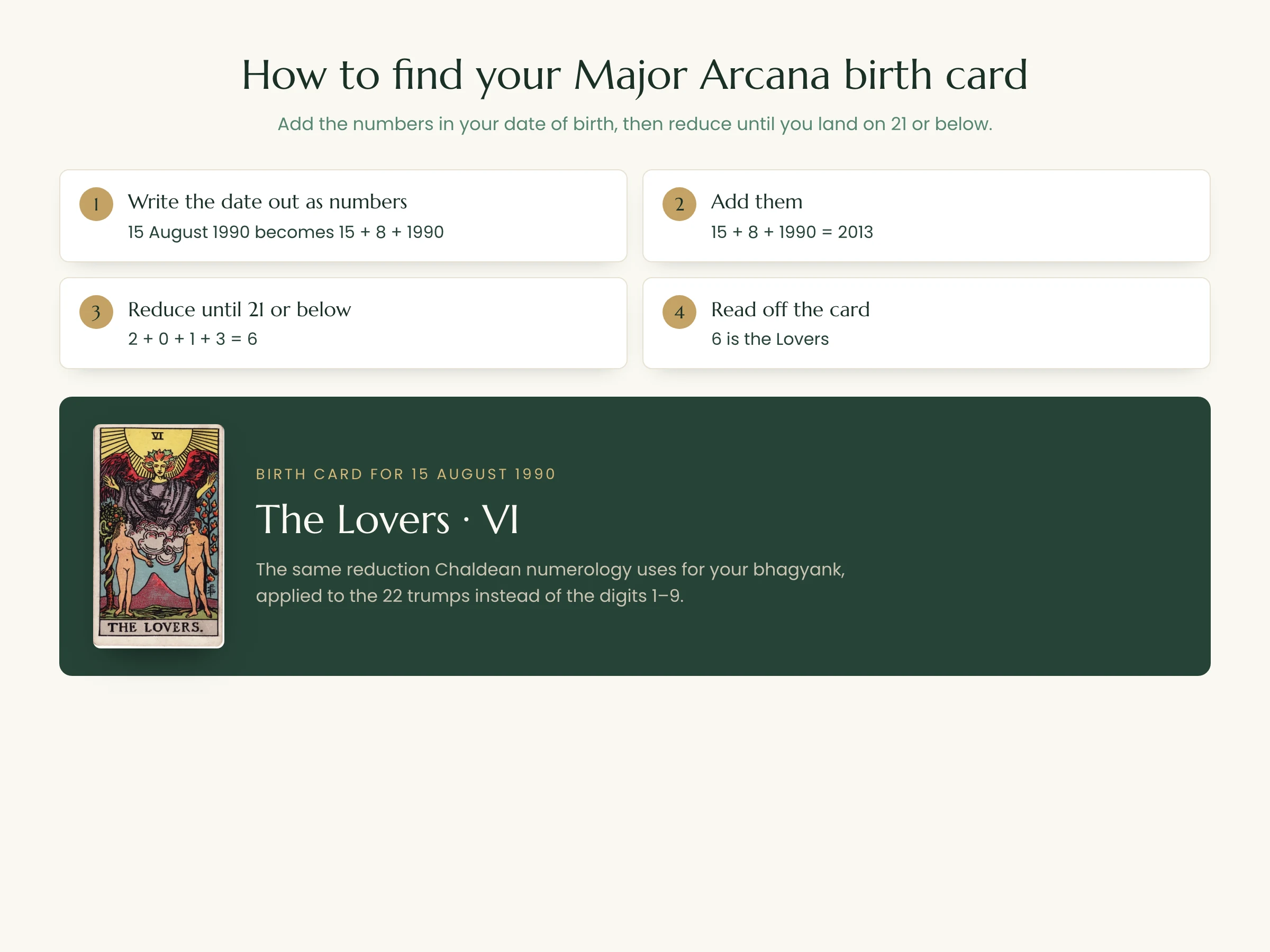
Your birth card is the major arcana card your date of birth reduces to. It takes about twenty seconds to work out and most write-ups on this topic skip it entirely.
Add the day, the month and the year as plain numbers. Then reduce the total until you reach 21 or below. That number is your card.
Worked through with 15 August 1990: 15 + 8 + 1990 comes to 2013. Reduce that and 2 + 0 + 1 + 3 gives 6. Six is the Lovers, so that is the birth card.
If your first total lands above 21, keep reducing. A 22 becomes 4, the Emperor. Nothing above XXI exists in this deck, so there is always a card at the end of it.
Some readers also work out a second card by reducing once more, so a birth card of 16 pairs with 7. Both methods are in circulation. I would rather you learn the single card properly than collect two you cannot use.
There is a related calculation worth knowing. Swap your birth year for the current one and the same sum gives a year card, which some readers use as a theme for the twelve months. It is a prompt for reflection, not a forecast, and I would not plan anything around it.
That reduction is the same arithmetic Chaldean numerology uses for your bhagyank, the destiny number drawn from your full date of birth. The only difference is where you stop: numerology reduces to a single digit, the birth card stops at 21 so it can land on a trump. If the numbers interest you more than the pictures, the numerology side of this practice works the same date much harder.
What a birth card is not is a personality verdict. I read it as a lifelong theme rather than a description of who you are. I would not let anyone hand you a fixed identity off the back of one sum.
Major arcana vs minor arcana: what is the difference?
The 22 majors are named and numbered. The 56 minors are split into four suits, Cups, Pentacles, Swords and Wands, and run ace to ten plus four court cards.
The practical difference is scale, not importance. A minor describes this week: a conversation, an invoice, a mood. A major describes the thing the week belongs to.
There is a second difference readers use constantly. Minors usually point at something you can act on directly. Majors more often describe the conditions you are acting inside, which is why the advice attached to them tends to be about stance rather than tactics.
Neither half outranks the other. A spread of all minors is not a small problem, and a spread of all majors is not a catastrophe.
The 22 to 56 split also explains a common misreading. Majors are rarer, so drawing several feels significant, and readers new to the deck often inflate that feeling into a prediction. Rarity is arithmetic, not emphasis.
Court cards sit in the minors and confuse this further, because they describe people and therefore feel weighty. They are still minors. Scale, not drama, is the dividing line.
What it means when the major arcana dominate a spread
Count them before you interpret anything. In a ten-card spread you would expect roughly two or three majors by chance, since they are 22 of 78 cards.
Noticeably more than that changes the reading. It usually means the question being asked out loud is smaller than the question actually on the table.
Someone asks whether to take a job. The spread comes back mostly majors. In my experience the real question is rarely the job. It is what taking it would mean about the life they have been building.
The reverse is worth noting too. A spread of almost all minors on a question that feels enormous is often a sign the situation is more workable than it feels from inside.
None of this requires counting precisely mid-reading. It is enough to notice whether the majors are crowding the spread, and to ask the person whether the question they gave you is the whole question.
The other thing I watch for is a single major among nine minors. That one card is usually where the reading actually is, and it is easy to skate past because everything around it looks ordinary.
How should you start learning the major arcana?
Learn them in order, not alphabetically and not by picking favourites. The sequence is doing most of the teaching.
Take one card a day and look at the picture before reading anything about it. Say what is literally in the image out loud. Most of what a card means is drawn on it, and reaching for a book first trains you to skip that.
Then read the card page here and see what you missed. That gap, between what you saw and what is there, is the thing that actually improves.
Pull one card each morning for a fortnight and write a single sentence about it at night. Twenty-two days gets you through the whole sequence with something written for each. The free 3-card tarot reading is a reasonable next step once single cards start making sense.
Do not start with reversals. Learn what each card says upright first, because a reversal is a modification of a reading you can already give. Adding it too early tends to produce two half-meanings instead of one whole one.
Learning the majors properly also makes the 56 minors much faster, because the themes repeat at a smaller scale. Most people find the second half of the deck takes less time than the first.
Common questions about the major arcana
Frequently Asked Questions
What are the 22 major arcana?
They run 0 to XXI. The first eleven are the Fool (0), the Magician (I), the High Priestess (II), the Empress (III), the Emperor (IV), the Hierophant (V), the Lovers (VI), the Chariot (VII), Strength (VIII), the Hermit (IX) and Wheel of Fortune (X). The rest are Justice (XI), the Hanged Man (XII), Death (XIII), Temperance (XIV), the Devil (XV), the Tower (XVI), the Star (XVII), the Moon (XVIII), the Sun (XIX), Judgement (XX) and the World (XXI).
How do I know what my major arcana card is?
Add the day, month and year of your birth as plain numbers, then reduce the total until it is 21 or below. That number is your birth card. For 15 August 1990: 15 + 8 + 1990 = 2013, then 2 + 0 + 1 + 3 = 6, which is the Lovers. It reads as a lifelong theme rather than a personality verdict.
Are there 12 major arcana in tarot?
No, there are 22, numbered 0 to XXI. The confusion usually comes from the 12 zodiac signs, which are mapped onto some of the cards, or from decks that group the trumps into sets. A standard 78-card tarot deck holds 22 majors and 56 minors.
What is the third major arcana card?
Counting from the Fool at 0, the third card is the Empress at III. If you count the Fool as the first card rather than zero, the third is the High Priestess at II. The numbering starting at 0 is the usual convention and the one used on this site.
Is a major arcana card more important than a minor one?
Not more important, just larger in scale. A minor arcana card describes this week, a major describes the situation the week belongs to. A spread full of majors does not mean disaster; it usually means the question being asked is smaller than the one actually on the table.
Where to go next
Every card above has its own page with the upright and reversed reading, what it means in love, career, money and health, and what it cannot tell you. Waite’s 1911 Pictorial Key to the Tarot is where most of these descriptions originate. The British Museum catalogued its own card holdings in 1876, in William Hughes Willshire’s A Descriptive Catalogue of Playing and other Cards in the British Museum.
Learn to read the whole deck
If you are working through the cards one at a time, that is how I teach them too. My live tarot course is a six-week, apply-only cohort covering all 78 cards, with the numerology layer sitting underneath each one, practice readings I give written feedback on, and a Foundation Reader certificate at the end. I teach it myself and I keep it small.
If you would rather talk it through with somebody who has no stake in your answer, my reading packages list fixed prices. There is no urgency attached, and there is nothing to buy beyond the session.
I am Lavanya Arora, a certified tarot reader and Chaldean numerologist based in Gurugram, Haryana. I have given over 4,000 paid sessions since 2019, hold 200+ verified five-star Google reviews, and was named Best Tarot Reader in India at the 2025 GHP Mental Health Awards.