10 min read · Updated Aug 1, 2026
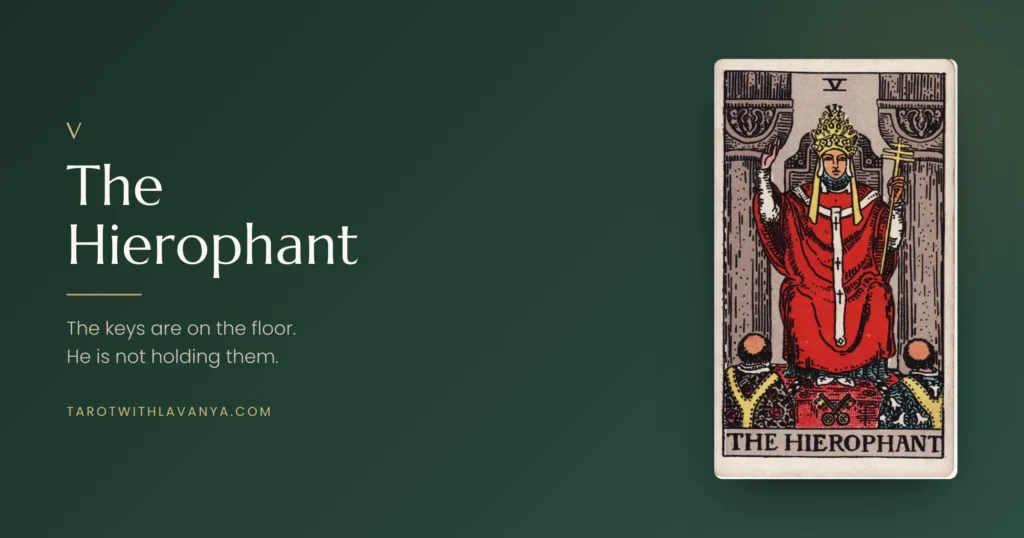
The Hierophant tarot card meaning is a method that already works, offered to you by somebody who did not invent it. Upright, the conventional route is the right one and using it is not a failure of imagination. Reversed, the rule is being kept past its usefulness, or dropped before it was understood.
The short answer. The Hierophant is card V, linked to Taurus, with earth as its element. Upright he describes tradition, teaching and belonging: a proven way of doing something, and a person or institution that hands it on. Reversed he describes rules followed without understanding, or discarded without a replacement. He is about method, not belief.
What the Hierophant cannot tell you
I want the limit named first, because this is the card most often mistaken for an instruction to obey.
The Hierophant cannot tell you whether the tradition is right. He tells you it exists, that it has worked before, and that somebody is offering it to you.
Those are different claims. Plenty of methods have worked for a long time and are still wrong for the person sitting in front of me.
He also cannot tell you whether the teacher is any good. Authority and competence are not the same thing, and this card only shows you the first one.
Most write-ups of the Hierophant tarot card meaning translate him as conformity, which I think misses the point badly. Conformity is doing it because everyone does. This card is about doing it because it works.
The question I actually ask is narrower. Has this person tried the ordinary route yet, or have they skipped it because it felt beneath them?
That answer is usually immediate and slightly embarrassing, which is a good sign it is the right question.
What does the Hierophant mean?
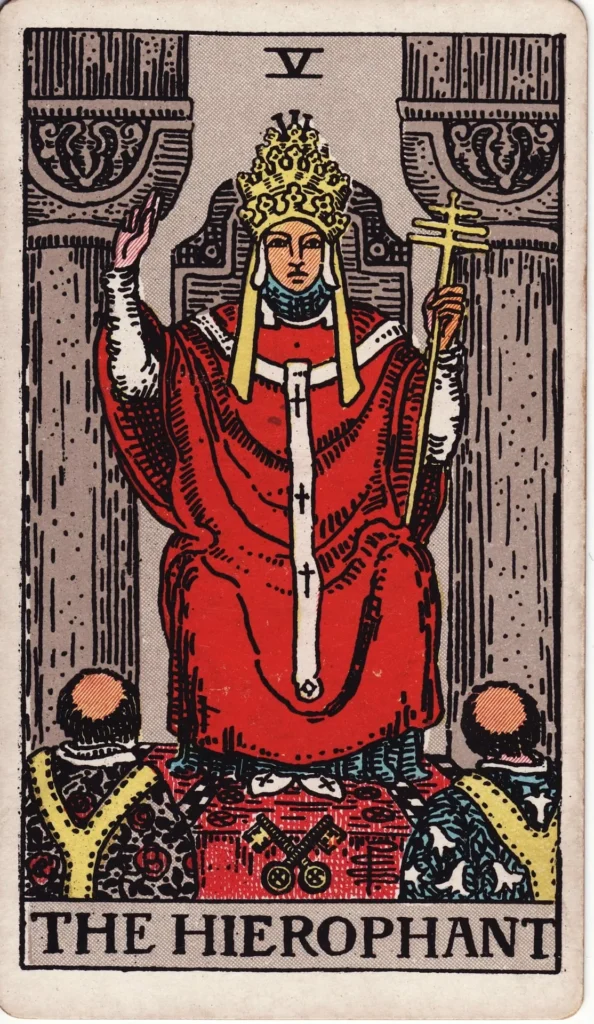
A figure in red sits between two pillars with one hand raised. Two students kneel below him, seen from behind.
It reads as a scene of authority, and it is. What it is not is a scene of enforcement, and the difference is in the details.
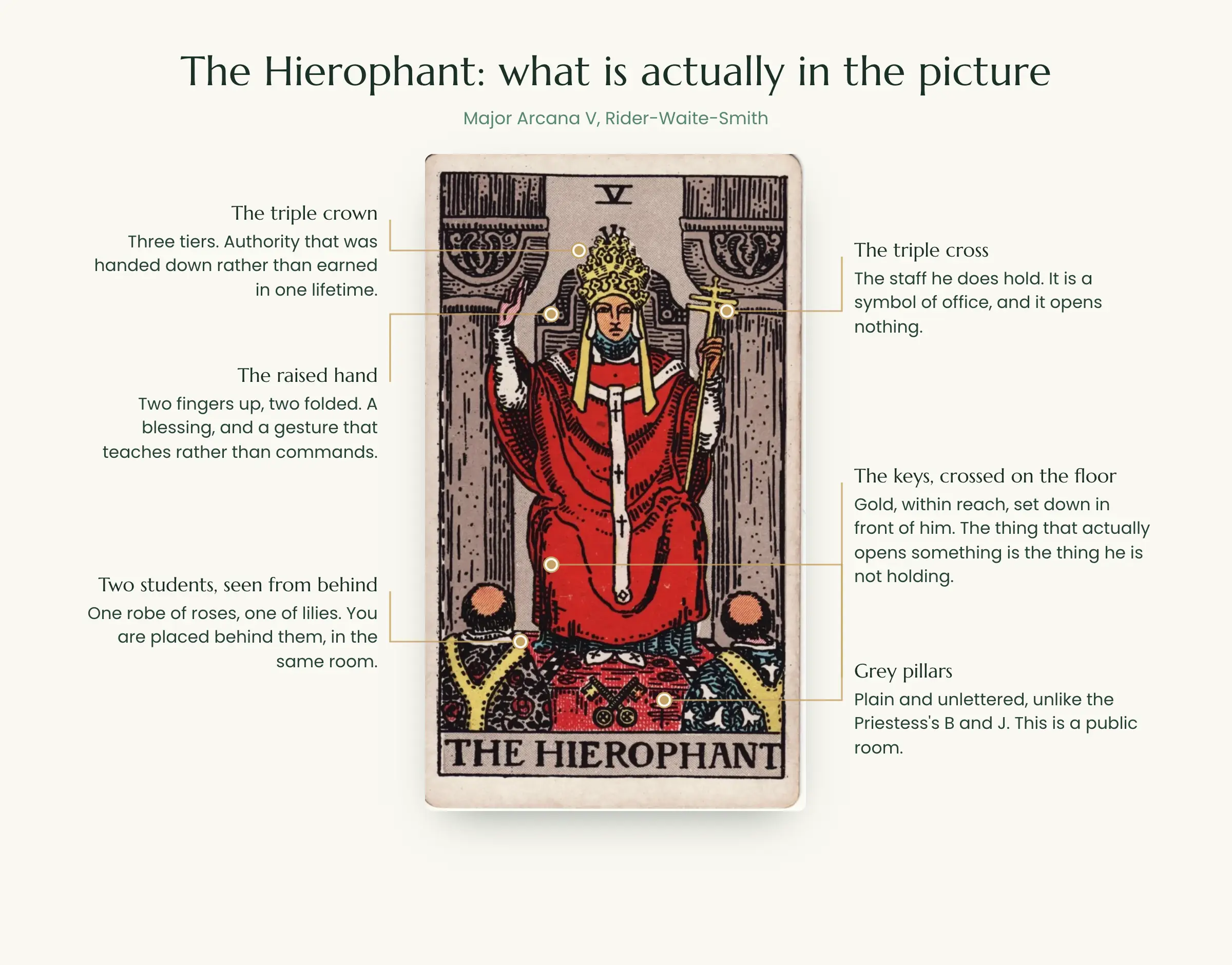
The crown has three tiers. Authority stacked up over time, handed down rather than earned in one lifetime.
His raised hand shows two fingers up and two folded. That is a blessing, not a command. Nobody in the picture is being made to do anything.
The two students are seen from behind, which places you in the room with them rather than opposite them. One robe carries roses, the other lilies, the same pairing that grows in the Magician’s garden.
The pillars here are plain and unlettered. Compare that with the High Priestess, whose pillars are marked B and J. Hers is a private chamber. This is a public room.
The detail most write-ups skip
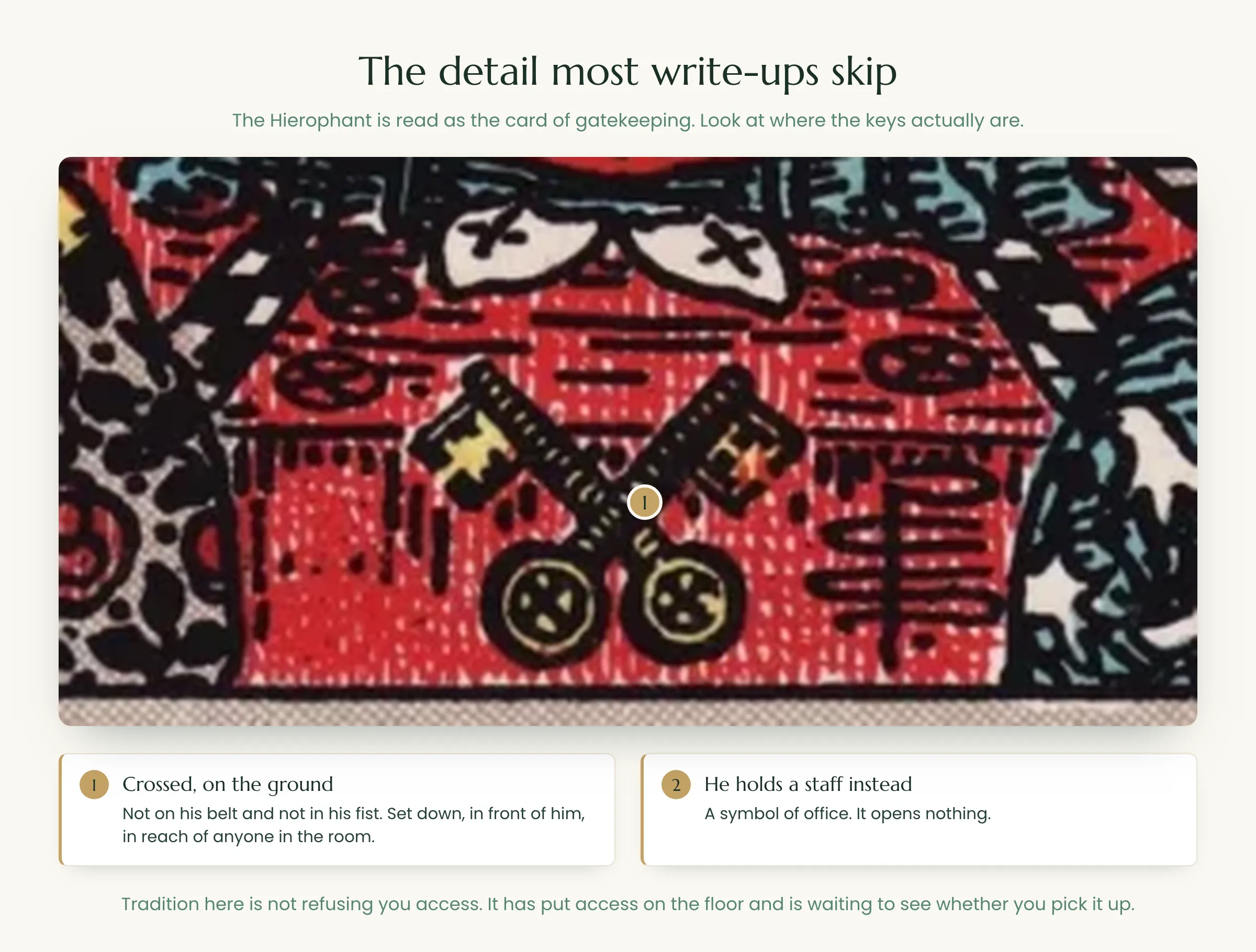
This card gets read as gatekeeping. So look at where the keys actually are.
They are on the floor. Two gold keys, crossed, lying on the ground in front of the throne, below his feet and within reach of the two people kneeling there.
He is not holding them. What he holds is a staff, and a staff is a symbol of office. It opens nothing.
I think that single choice reframes the whole card. The thing that actually opens something has been set down in front of you.
Tradition, drawn this way, is not refusing you access. It has put access on the floor and is waiting to see whether you bother to pick it up.
That also explains why he so often turns up for people who are stuck. The route is available and unglamorous, and they have been looking for a different one.
Waite’s 1911 Pictorial Key to the Tarot is where these descriptions come from, and the card’s documented history fills in the rest.
For the older documentary trail, the British Museum catalogued its own card holdings in 1876. William Hughes Willshire’s A Descriptive Catalogue of Playing and other Cards in the British Museum lists the trumps one by one.
The Hierophant upright: what he asks of you
The Hierophant tarot card meaning upright rests on one question. Have you actually tried the ordinary way?
Not researched it. Not decided it would not work for you. Tried it, properly, for long enough to know.
His instruction is the same everywhere. Find the person who has done this before and ask them how. It is duller than improvising and it is faster.
In love
Upright, this covers commitment with a structure around it. Moving in, marriage, meeting the families, saying it out loud to other people.
It also covers a relationship where shared values are doing more work than chemistry. That is not a lesser thing, whatever the films say.
Where he complicates matters is family expectation, which in Indian households is rarely a small factor. The card does not tell you to comply. It tells you the structure is real and worth naming rather than pretending away.
The free daily love tarot reading will pull a card on one question if you want a prompt today. It is automated and free, and a prompt is all it is.
This week: name one expectation you are carrying that nobody has actually stated.
In career
Upright, this is qualifications, mentorship and the established path. The certificate, the apprenticeship, the person one rung up who would tell you if you asked.
It comes up constantly for people trying to shortcut a field they have not learned yet. The card is not scolding them. It is pointing at a faster route they have dismissed as slow.
It also describes being the Hierophant yourself, which arrives earlier than most people expect. Somebody junior is already watching how you do it.
The free daily career tarot reading gives you one card on one question if today is the day you look at it.
This week: ask one person who has already done it how they did it.
In money
Upright, the boring instrument is the correct one. The index fund, the fixed deposit, the emergency buffer nobody boasts about.
He shows up against schemes. Not because clever money never works, but because the conventional version is the one you can explain to yourself at two in the morning.
A card is not financial advice. Before you commit money to anything, speak to a qualified financial adviser who can look at your actual position.
This week: set up the dull automatic thing you have been meaning to set up.
In health
Upright, this is conventional care. The doctor, the physiotherapist, the boring protocol with evidence behind it.
It often lands for people deep in alternative routes who have not yet tried the standard one. A reading is not medical advice and is not a substitute for a doctor, and this is the card least inclined to pretend otherwise.
The free wellness tarot reading is free and automated if you want a prompt alongside the appointment.
This week: book the standard appointment before researching anything else.
As someone’s feelings
When the Hierophant describes how somebody feels about you, they are thinking in terms of a future with a shape.
Serious, and slightly formal about it. This is often somebody who would rather do the thing properly than quickly, and who is quietly checking whether you want the same.
This week: say what shape you actually want, before assuming theirs.
What does the Hierophant reversed mean?
Reversed, the relationship with the rule has broken, and it breaks in two opposite ways.
The first is the rule kept long after anyone remembers why. Doing it this way because it has always been done this way, which is the weakest reason there is.
The second is rejection without understanding. Discarding the method before learning what it was for, which usually means rebuilding it badly from scratch later.
The Hierophant tarot card meaning in reverse is often written as rebellion, and that flatters it. Real rebellion knows exactly what it is refusing. This is usually just impatience.
Both versions are fixed the same way. Find out what the rule was protecting before you decide what to do with it.
In love, reversed
At one end, a relationship held in shape by obligation and other people’s expectations rather than by either person wanting it.
At the other, refusing every structure on principle, which tends to leave one person quietly doing all the planning.
If an ex is occupying the thinking, that is worth naming rather than working around. The relationship tarot posts cover that ground properly.
This week: ask whether you want the thing itself or the approval attached to it.
In career, reversed
Reversed, this is the process nobody can justify and everybody follows. It also covers a mentor whose advice stopped fitting two years ago.
The opposite version is the person who will not learn the standard method because they are certain they can improvise it.
This week: ask why one process exists, of somebody who was there when it was made.
In money, reversed
Reversed, either an inherited money habit that no longer suits your actual income, or the clever scheme that skips the fundamentals.
Both are the same error. One trusts the rule without checking it, the other discards it without reading it.
Speak to a qualified adviser before anything significant moves, particularly if the decision feels urgent.
This week: write down one money rule you inherited and whether it still applies.
In health, reversed
Reversed, this is advice being followed without being understood, or standard care being rejected on principle.
Ask the question you have been too polite to ask at the appointment. A reading is not medical advice, and a qualified professional is the person who should be answering it.
This week: ask your doctor why, and keep asking until the answer makes sense.
As someone’s feelings, reversed
They want you and not the shape that would come with it, or they want the shape and are not sure about you.
Those two are easy to confuse from the outside and they behave very differently over six months. Watch which one the evidence supports.
This week: notice whether they make plans that include a date.
Is the Hierophant a yes or no card?
Upright, the Hierophant is a yes. It is a yes to the conventional version of the thing, done the established way.
Reversed it reads as a no, and usually a no to the method rather than the goal. The plan needs the ordinary route added back in.
I find his yes one of the more practical in the deck, because it comes with instructions attached.
For a single yes-or-no question you can pull one now with the free yes/no tarot reading, which is free and automated. What it cannot ask is whether you have tried the obvious thing, which is this card’s whole question.
How the Hierophant differs from the Emperor and the High Priestess
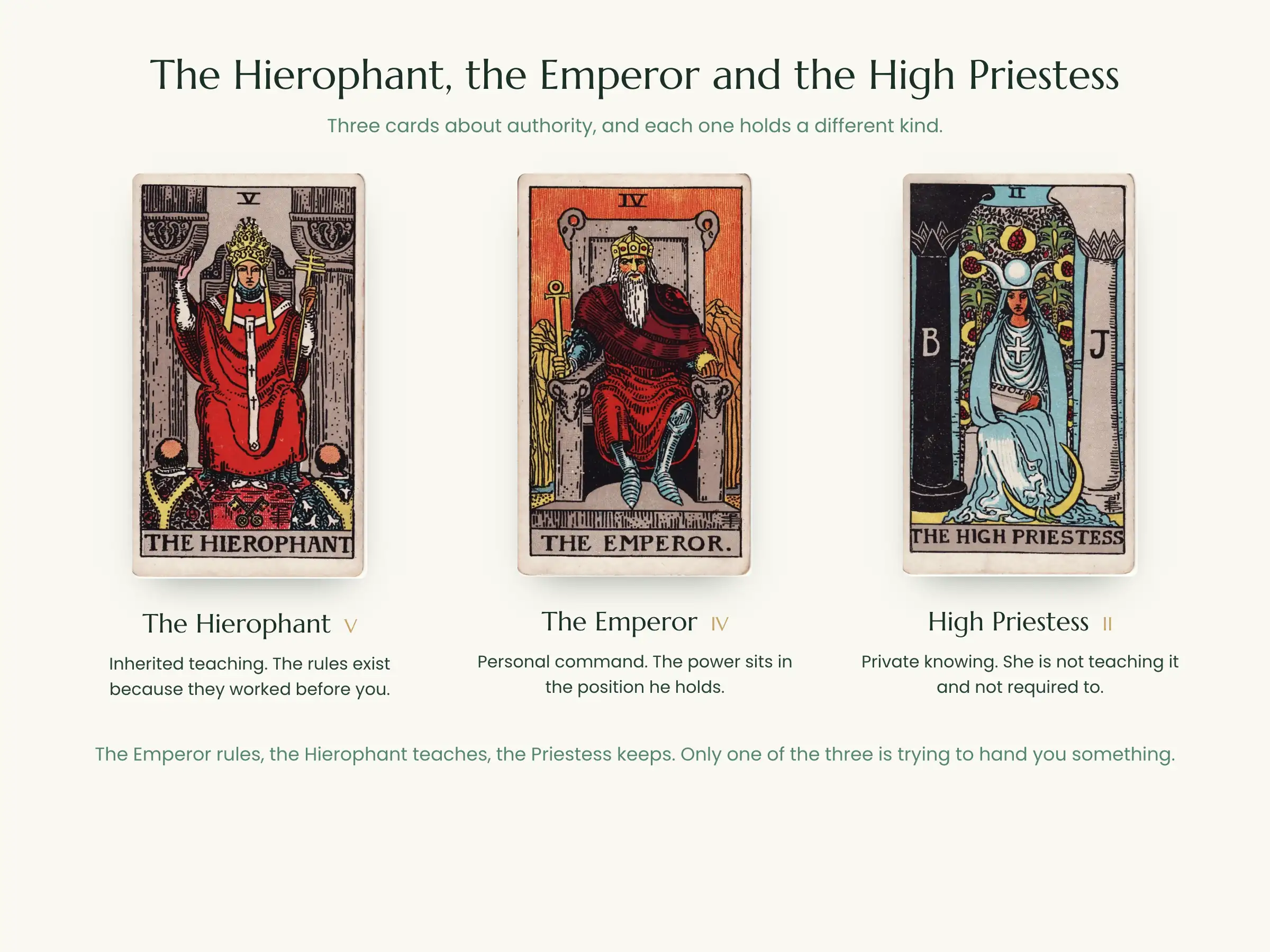
These three all carry authority, and each one holds a different kind. Separating them makes every reading with them cleaner.
The Emperor holds personal command. The power sits in the position, and it ends when he leaves it.
The Hierophant holds inherited teaching. His authority came from before him and will outlast him, which is why he can afford to put the keys down.
The High Priestess holds private knowing. She is not teaching it, and she is not obliged to.
Put plainly: the Emperor rules, the Hierophant teaches, the Priestess keeps. Only one of the three is trying to hand you something.
Reading the Hierophant with the cards around it
One card names the method. The cards beside it tell you what it is being applied to.
With Pentacles, it is training, qualifications or money, and the advice is almost always literal. With Cups, it is a commitment taking a formal shape.
Next to the Lovers, which follows him, read the pair in order. He offers the established answer. The next card asks whether you actually choose it.
With Swords, check whether the rule is being examined or merely argued about. Those look identical and are not.
Next to the Tower, the structure he represents is the thing about to be tested, and it is worth knowing which parts you would rebuild.
The Hierophant cliff notes
The Hierophant tarot card meaning in one table, for when you have the deck out and want the answer quickly.
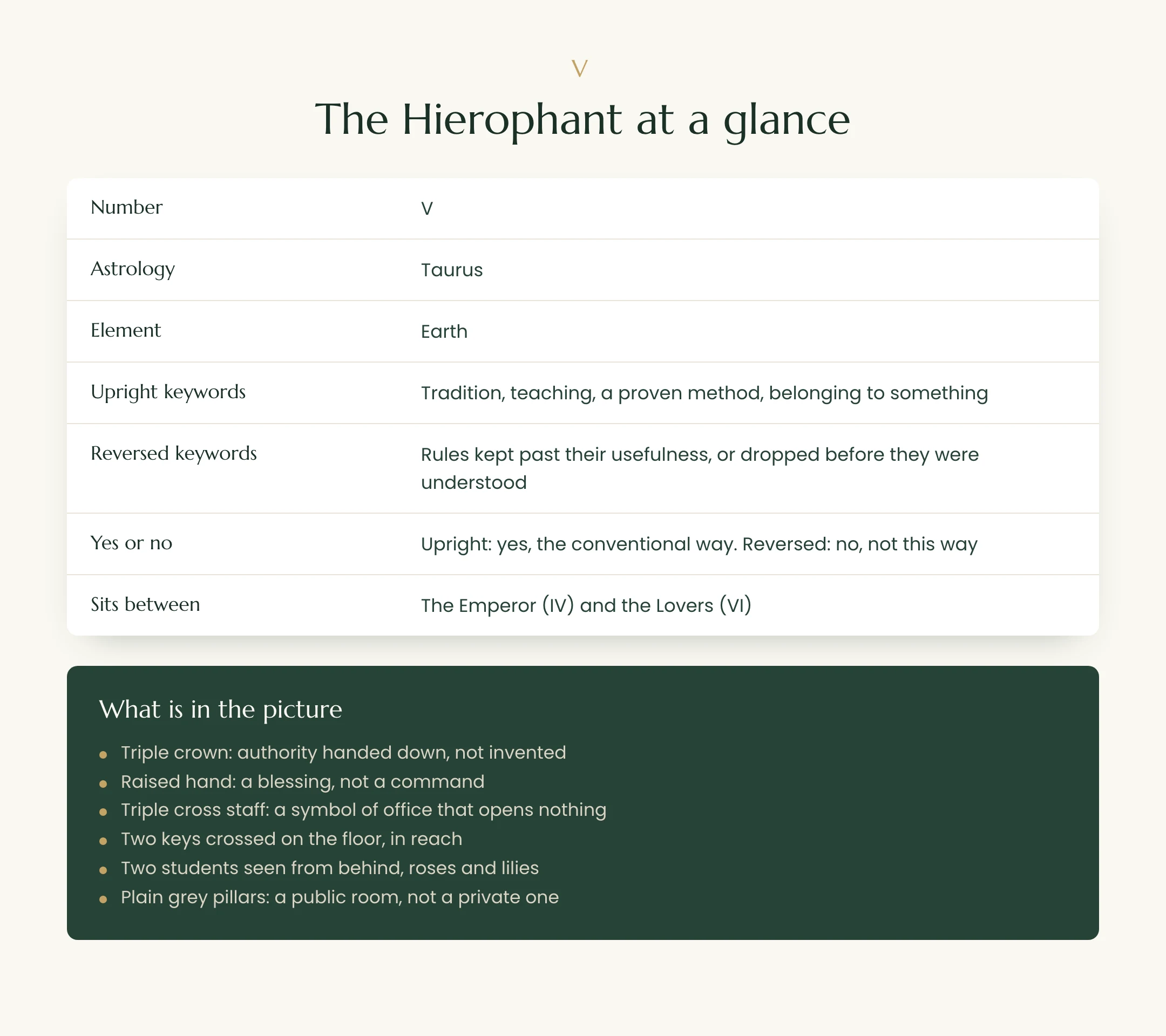
| Attribute | Detail |
|---|---|
| Number | V |
| Astrology | Taurus |
| Element | Earth |
| Upright keywords | Tradition, teaching, a proven method, belonging |
| Reversed keywords | Rules kept past their use, or dropped before being understood |
| Yes or no | Upright: yes, the conventional way. Reversed: no, not like this |
| Sits between | The Emperor (IV) and the Lovers (VI) |
What is in the picture
- A triple crown: authority handed down, not invented
- A raised hand in blessing, not command
- A triple cross staff, which is a symbol of office and opens nothing
- Two keys crossed on the floor, in reach of anyone kneeling there
- Two students seen from behind, one in roses and one in lilies
What should you do this week if you drew the Hierophant?
Pick up the keys, which in practice means doing the unglamorous available thing.
Write down the standard route for whatever you are stuck on. Not the clever one. The one everybody who has solved this already used.
Then ask honestly whether you have tried it or dismissed it. If you dismissed it, the reason is worth writing down too, because it is usually about self-image rather than the method.
On timing, I will be blunt, because plenty of sites will hand you a month. Timing is the weakest thing tarot does, and I would rather say so than invent a date for you.
Common questions about the Hierophant
Frequently Asked Questions
Is the Hierophant a good card to draw?
He is a practical card rather than an exciting one. Upright he says the established route is the right one and comes with instructions attached. Reversed he says a rule is being kept without understanding or dropped without a replacement, and names that as the thing to fix.
Does the Hierophant mean marriage?
Sometimes, and not on its own. He describes commitment that takes a formal shape, which covers marriage but also moving in, meeting families, or simply saying it out loud to other people. What he does not do is promise a date, and no card can.
Why are the keys on the floor of the Hierophant card?
Because he is not holding them. Two gold keys lie crossed on the ground in front of the throne, within reach of the two students. He holds a staff instead, which is a symbol of office and opens nothing. Access has been set down rather than withheld.
What does the Hierophant reversed mean?
One of two opposite things. Either a rule is being followed long after anyone remembers why, or a method is being rejected before it was understood. Both are fixed the same way: find out what the rule was protecting before deciding what to do with it.
How is the Hierophant different from the Emperor?
The Emperor holds personal command and his power ends when he leaves the position. The Hierophant holds inherited teaching that came from before him and will outlast him. The Emperor rules, the Hierophant teaches, and only one of them is trying to hand you something.
Where to go next
If you are working through the deck yourself, the tarot card meanings cluster covers the Major Arcana one card at a time. The Lovers is the natural next read, and the free 3-card tarot reading is a good step once single cards start making sense.
Learn to read the whole deck
If you are working through the cards one at a time, that is how I teach them too. My live tarot course is a six-week, apply-only cohort covering all 78 cards, with the numerology layer sitting underneath each one, practice readings I give written feedback on, and a Foundation Reader certificate at the end. I teach it myself and I keep it small.
If you would rather talk it through with somebody who has no stake in your answer, my reading packages list fixed prices. There is no urgency attached, and there is nothing to buy beyond the session.
I am Lavanya Arora, a certified tarot reader and Chaldean numerologist based in Gurugram, Haryana. I have given over 4,000 paid sessions since 2019, hold 200+ verified five-star Google reviews, and was named Best Tarot Reader in India at the 2025 GHP Mental Health Awards.