
11 min read · Updated Aug 1, 2026
Mulank (मूलांक) is your root number in Vedic numerology, calculated from the day of the month you were born and nothing else. Born on the 15th? Your Mulank is 6, because 1 + 5 = 6. Born on the 7th, 17th or 27th? Your Mulank is 7.
The word is Sanskrit: mool means root, ank means number — which is why you will also see it spelled moolank. Both spellings mean the same number. It is the number that describes your instinctive self, the person you are before you think about it, and it is ruled by one of the nine planets of Indian astrology.
This guide covers what Mulank means, how to calculate yours in about ten seconds, what each of the nine Mulanks carries, and the part most articles skip: how Mulank differs from Bhagyank and from the Western Life Path number. Those three get mixed up constantly, including by people who should know better.
Jump straight to the Mulank 1–9 chart →
How to Calculate Your Mulank
Take the day of the month you were born. Ignore the month. Ignore the year. Add the digits together until you get a single digit from 1 to 9.
- Born on the 8th → Mulank 8 (single digit already)
- Born on the 15th → 1 + 5 = Mulank 6
- Born on the 29th → 2 + 9 = 11 → 1 + 1 = Mulank 2
- Born on the 31st → 3 + 1 = Mulank 4
If you would rather not do the arithmetic, the mulank and bhagyank calculator works both numbers out from your date of birth and shows every step.
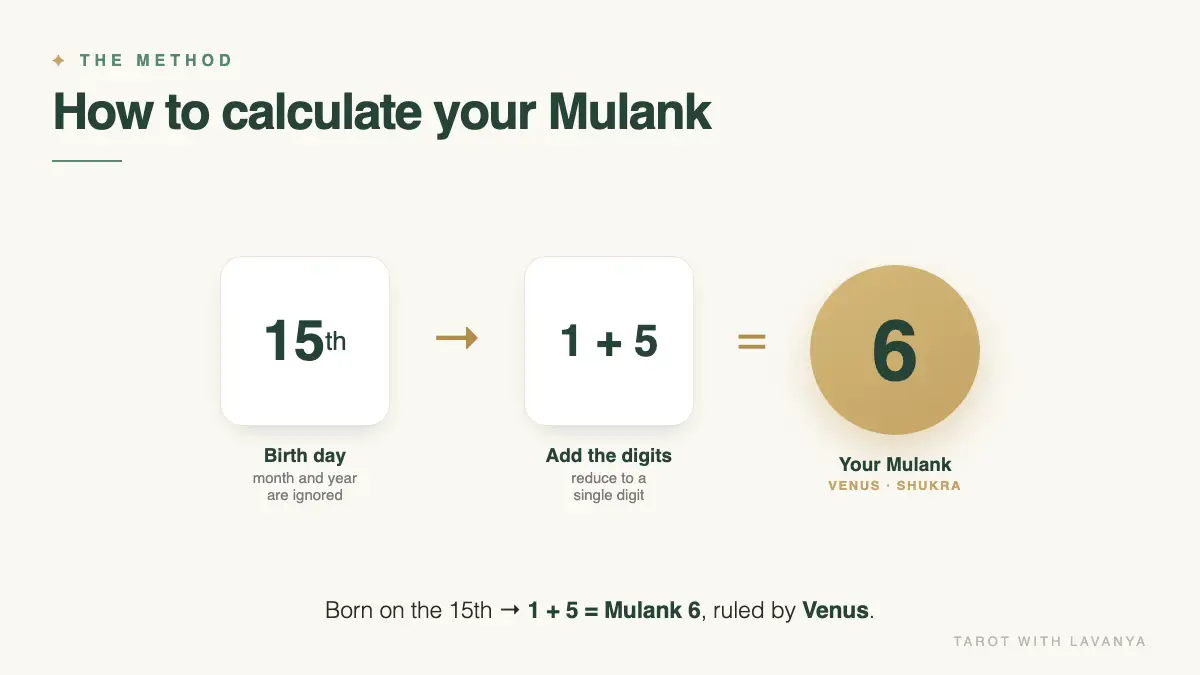
That is the whole method. There are only 31 possible birth days, so there are only nine possible Mulanks, and every date reduces cleanly. If you were born on the 11th or 22nd, note that Mulank reduces them to 2 and 4 — the master-number treatment belongs to Bhagyank and Life Path, not to Mulank.
If you would rather not do the arithmetic, use our free numerology calculator as a mulank calculator — it returns your Root number (Mulank) and Destiny number (Bhagyank) from your name and date of birth.
Mulank 1 to 9: The Complete Chart
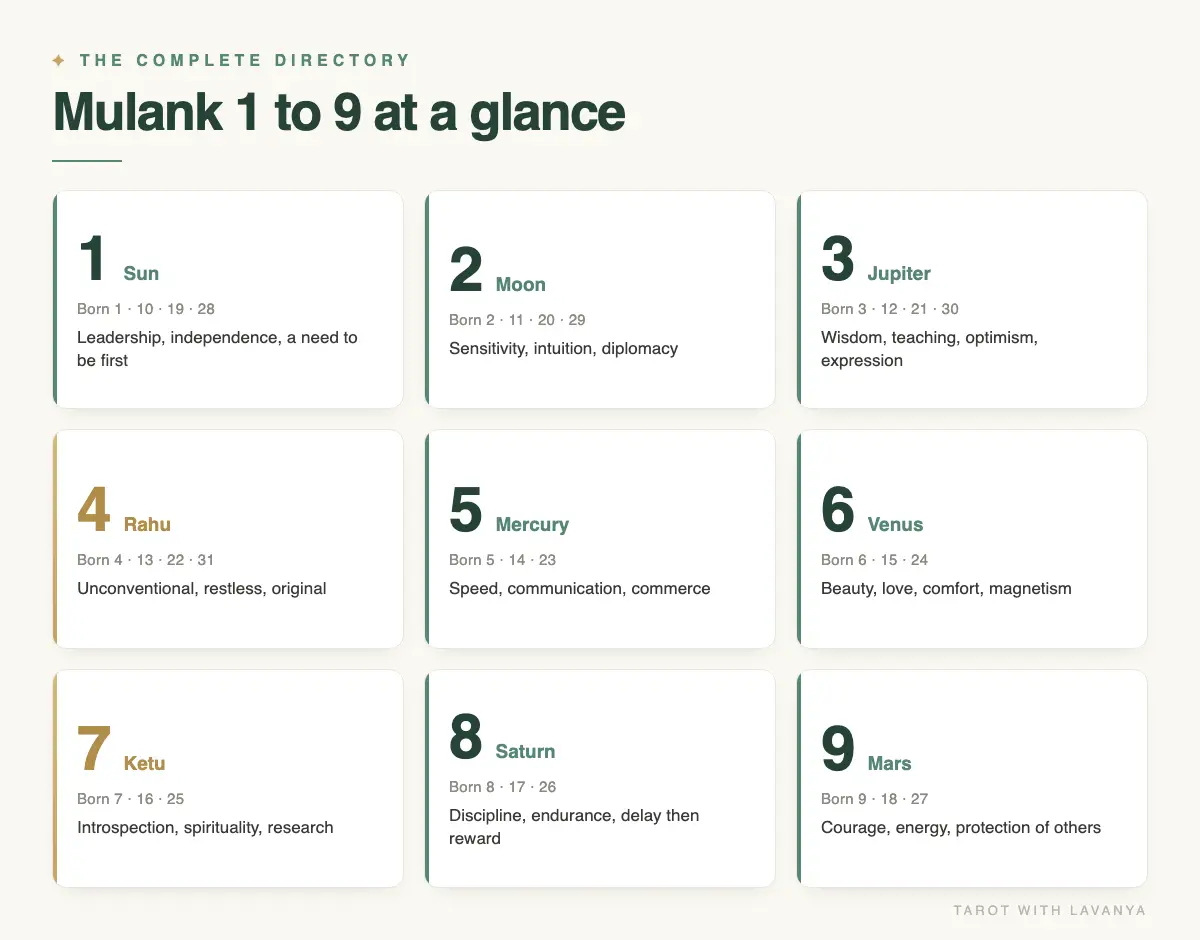
Each Mulank is governed by a planet, and the planet is what gives the number its character. This Mulank chart is the table I work from in consultations.
| Mulank | Born on | Planet | Core nature |
|---|---|---|---|
| 1 | 1, 10, 19, 28 | Sun (Surya) | Leadership, independence, authority, a need to be first |
| 2 | 2, 11, 20, 29 | Moon (Chandra) | Sensitivity, intuition, diplomacy, changeable moods |
| 3 | 3, 12, 21, 30 | Jupiter (Guru) | Wisdom, teaching, optimism, expression |
| 4 | 4, 13, 22, 31 | Rahu | Unconventional, restless, original, hard-working |
| 5 | 5, 14, 23 | Mercury (Budh) | Speed, communication, commerce, adaptability |
| 6 | 6, 15, 24 | Venus (Shukra) | Beauty, love, comfort, home, magnetism |
| 7 | 7, 16, 25 | Ketu | Introspection, spirituality, research, detachment |
| 8 | 8, 17, 26 | Saturn (Shani) | Discipline, delay then reward, endurance, structure |
| 9 | 9, 18, 27 | Mars (Mangal) | Courage, energy, conflict, protection of others |
A quick note on Rahu and Ketu, because Western numerology has no equivalent and it confuses people. They are not planets in the astronomical sense — they are the lunar nodes, the two points where the Moon’s path crosses the Sun’s. Indian tradition treats them as shadow planets with real influence. Mulank 4 and Mulank 7 are the two numbers they govern, which is why those two are the least conventional numbers in the set.
Where this table comes from, and where the sources disagree
The number-to-planet mapping above is not universally agreed, and it is worth seeing where the published authorities differ rather than taking any single table on trust.
Cheiro, whose Book of Numbers is the text most modern numerology descends from, sets his correspondences out as: Sun 1, Moon 2, Jupiter 3, Uranus 4, Mercury 5, Venus 6, Neptune 7, Saturn 8, Mars 9. Sepharial, in The Kabala of Numbers (1920), lists the answering planets as: 1 the Sun, 2 the Moon (new), 3 Jupiter, 4 the Earth or Sun, 5 Mercury, 6 Venus, 7 the Moon (full), 8 Saturn, 9 Mars.
Set those against the Ank Jyotish table above and the pattern is hard to miss. All three agree exactly on seven of the nine: 1 Sun, 2 Moon, 3 Jupiter, 5 Mercury, 6 Venus, 8 Saturn, 9 Mars. They part company on precisely two numbers, 4 and 7, which are the same two that Indian practice assigns to Rahu and Ketu.
Cheiro does not use the words Rahu or Ketu anywhere in the book. Where Ank Jyotish names the two lunar nodes, he names Uranus and Neptune, the two planets discovered too late to appear in any classical system. The chart on this page follows the Ank Jyotish attribution, which is the older of the two. If you read Cheiro alongside it, 4 and 7 are the numbers where his profiles and these will diverge.
What Each Mulank Means: Full Profiles 1 to 9
The chart above is the quick version. Below is what each Mulank actually looks like in a person — the strength, the shadow, the work that suits it, and the numbers it tends to get along with. On compatibility, treat these as tendencies rather than rules: traditions differ on the finer points, and a full chart reading weighs Mulank against Bhagyank before drawing conclusions.
Mulank 1 — ruled by Sun (Surya)
Born on the 1, 10, 19, 28. Natural authority. A Mulank 1 is decisive, original, and happiest when they own the outcome. They start things other people only talk about.
The shadow side: Ego, and a real allergy to being told what to do. Under stress a 1 isolates rather than asks for help.
Work that suits it: Founder, executive, civil service, consulting — anything with their name on it. Generally harmonises with: 2, 3, 5 and 9.
A 1 needs to lead something, even if it is small. A 1 with no authority anywhere becomes difficult to live with.
Mulank 2 — ruled by Moon (Chandra)
Born on the 2, 11, 20, 29. Reads a room before anyone speaks. Diplomatic, patient, and genuinely cooperative — the person who holds a team together.
The shadow side: Mood swings, indecision, and taking things personally. Avoids conflict until it becomes a crisis.
Work that suits it: Counselling, HR, hospitality, design, care work, and any real partnership. Generally harmonises with: 1, 3, 5 and 7.
Sleep and water matter more for a 2 than for any other number. A tired 2 is a different person.
Mulank 3 — ruled by Jupiter (Guru)
Born on the 3, 12, 21, 30. Expressive and quick to learn. A Mulank 3 teaches without meaning to, and can make almost any idea sound worth doing.
The shadow side: Scattered attention and over-promising. Depth loses to variety.
Work that suits it: Teaching, law, media, content, advisory work, finance. Generally harmonises with: 1, 2, 6 and 9.
A 3 needs external structure. Left alone they start far more than they finish.
Mulank 4 — ruled by Rahu
Born on the 4, 13, 22, 31. Original and genuinely hard-working. A Mulank 4 sees the flaw everyone else walked past, and is unbothered by doing things the unusual way.
The shadow side: Restlessness, arguing for its own sake, and a habit of self-sabotage just as things settle.
Work that suits it: Technology, research, engineering, reform and activism — anything unorthodox. Generally harmonises with: 5, 6, 7 and 8.
Routine is medicine for a 4, not a cage. The more unstable the outer life, the more the daily structure has to hold.
Mulank 5 — ruled by Mercury (Budh)
Born on the 5, 14, 23. Fast, persuasive and commercially sharp. A Mulank 5 adapts to any room and usually leaves it having got what they came for.
The shadow side: Over-commits, gets bored, and money moves out as quickly as it comes in.
Work that suits it: Sales, trading, media, travel, communications, entrepreneurship. Generally harmonises with: almost everyone — especially 1, 2, 4, 6 and 9.
The most fluid number in the set. The single most useful thing a 5 can do is finish one thing before starting the next.
Mulank 6 — ruled by Venus (Shukra)
Born on the 6, 15, 24. Magnetic and genuinely artistic. A Mulank 6 makes a home people want to stay in, and is generous with anyone they have claimed.
The shadow side: Indulgence, conflict avoidance, and over-investment in what others think of them.
Work that suits it: Design, fashion, hospitality, luxury goods, events, counselling. Generally harmonises with: 3, 4, 5, 8 and 9.
Budget the pleasure rather than denying it. Venus does not respond well to being refused, only to being planned for.
Mulank 7 — ruled by Ketu
Born on the 7, 16, 25. Analytical and quietly intuitive. A Mulank 7 is comfortable alone and will research something to the bottom while others are still guessing.
The shadow side: Detachment, overthinking, and a secrecy that shuts out the people closest to them.
Work that suits it: Research, data, medicine, investigation, writing, spiritual work. Generally harmonises with: 2, 4 and 8.
Solitude is both fuel and trap for a 7. The work is noticing which one it is on any given week.
Mulank 8 — ruled by Saturn (Shani)
Born on the 8, 17, 26. Endurance. A Mulank 8 builds things that outlast them and keeps going long after quicker numbers have moved on.
The shadow side: Delay, heaviness, rigidity, and resentment when the effort goes unrecognised.
Work that suits it: Business, law, construction, mining, finance, administration. Generally harmonises with: 4, 6 and 7.
8 is not an unlucky number, it is a slow one. What an 8 earns tends to stay earned — the difficulty is the waiting.
Mulank 9 — ruled by Mars (Mangal)
Born on the 9, 18, 27. Courage and sheer energy. A Mulank 9 protects people and will take on a fight that was never theirs to begin with.
The shadow side: Anger, impatience, burnout, and picking battles that cost more than they return.
Work that suits it: Defence, sport, surgery, emergency work, activism, leadership. Generally harmonises with: 1, 3, 5 and 6.
A 9 needs a physical outlet. Without one the energy turns inward and comes out as temper.
Mulank vs Bhagyank vs Life Path
This is where most confusion lives, and it is worth getting right before you read anything else about your numbers.
- Mulank (root number) comes from your birth day only. It describes your instinctive nature — how you react before you think.
- Bhagyank (destiny number) comes from your full date of birth — day, month and year added together. It describes the arc of your life and what you are working toward.
- Life Path is the Western name for the same calculation as Bhagyank. Life Path and Bhagyank are the same number under two names.
Say it plainly: Life Path = Bhagyank. Life Path is not Mulank. If an article tells you your “Life Path number” is calculated from your birth day alone, it is wrong, and you will end up reading the wrong profile.
The mulank and bhagyank calculator gives you both numbers side by side, which is the quickest way to see that they are not the same.
Worked example. Someone born on 15 August 1990.
- Mulank: 1 + 5 = 6 (Venus)
- Bhagyank: 1+5 + 8 + 1+9+9+0 = 33 → 3 + 3 = 6
Here both come to 6, which happens sometimes and makes for a very consistent person — instinct and direction pulling the same way. Far more often the two numbers differ, and the gap between them is the interesting part of a reading. A Mulank 1 with a Bhagyank 2 is someone whose instinct is to lead but whose life keeps asking them to cooperate. That tension is not a flaw. It is usually the whole lesson.
Because Bhagyank and Life Path are the same number, the full Life Path profiles on this site apply directly to your Bhagyank: 1, 2, 3, 4, 5, 6, 7, 8, and 9.
Which Mulank Is the Luckiest?
None of them, and I say that as someone asked this question almost every week.
There is no universally lucky Mulank. What exists is fit — between your Mulank, your Bhagyank, the work you have chosen, and the people around you. Mulank 8 has a reputation for hardship because Saturn delays things, and yet a great many genuinely successful people in business carry it, because Saturn also rewards endurance more reliably than any other planet. Mulank 5 is called lucky because Mercury moves fast and money moves with it, but a 5 who never finishes anything stays poor.
The number tells you what you are working with. It does not tell you what you will do with it.
How Mulank Actually Shows Up in a Reading
In practice I use Mulank as the fastest read on a person. It is the number I calculate first, because it tells me how someone will react under pressure before they have had time to be polite about it.
A Mulank 1 walks into a consultation and takes charge of it. A Mulank 2 asks what I think before offering an opinion. A Mulank 4 has usually read three contradictory articles before arriving and wants to argue with one of them. A Mulank 9 tends to ask about someone else’s problem before their own. None of this is in the textbooks. It is just what a decade of sitting across from people does to your pattern recognition.
What I look for is the relationship between Mulank and Bhagyank. When they agree, the person is usually clear about who they are and frustrated that life is not moving faster. When they disagree, the person is usually more capable than they believe, because they have spent their life being pulled in two directions and have quietly learned both.
Mulank and Ank Jyotish
Ank Jyotish (अंक ज्योतिष) is simply the Sanskrit name for numerology — ank number, jyotish astrology. Mulank is one of its three core numbers, alongside Bhagyank and Namank, the name number.
The system is older than the Western tradition and works on a different logic. Western numerology maps letters to numbers by alphabetical position. Ank Jyotish ties every number to a planet, which means a numerology reading and an astrology reading should agree with each other. When they do not, one of them has been done carelessly.
If your name matters to you as much as your birth date, the third number — Namank — is calculated from the letters of your name using the Chaldean tables. You can check yours with the lucky name numerology calculator.
Frequently Asked Questions
How do we calculate Mulank?
Add the digits of the day of the month you were born until you get a single digit. Ignore the month and the year entirely. Born on the 15th gives 1 + 5 = Mulank 6. Born on the 29th gives 2 + 9 = 11, then 1 + 1 = Mulank 2.
What is Mulank in astrology?
Mulank is the root or birth number in Vedic numerology, also called Ank Jyotish. It is derived from your birth day and is governed by one of nine planets, including the shadow planets Rahu and Ketu. It describes instinctive nature rather than life direction.
Which Mulank is considered lucky?
No single Mulank is universally lucky. Each of the nine carries strengths and difficulties determined by its ruling planet. What matters is the fit between your Mulank, your Bhagyank, and the life you are actually living. Mulank 8 is often called unlucky because Saturn delays results, but it rewards persistence more reliably than any other number.
What is the difference between Mulank and Bhagyank?
Mulank comes from your birth day alone and describes your instinctive nature. Bhagyank comes from your full date of birth, day month and year, and describes your life direction. Bhagyank is the same number Western numerology calls the Life Path.
Is Mulank the same as Life Path number?
No. Life Path is calculated from the complete date of birth, which makes it equivalent to Bhagyank, not Mulank. Mulank uses the birth day only. Confusing the two is the most common error in numerology articles and leads people to read the wrong profile.
What is Mulank 1 to 9?
The nine Mulanks and their ruling planets are: 1 Sun, 2 Moon, 3 Jupiter, 4 Rahu, 5 Mercury, 6 Venus, 7 Ketu, 8 Saturn, 9 Mars. Your Mulank is determined by the day of the month you were born, reduced to a single digit.
Final thoughts
Mulank is the simplest number in your chart and the one people underrate most. It takes ten seconds to calculate and it explains a surprising amount about why you react the way you do.
But it is one number out of several, and reading it alone is like judging a person by their first sentence. Mulank, Bhagyank and Namank together give you something closer to the truth.
If you want all three read properly against each other rather than in isolation, you can explore a numerology reading here.