10 min read
The Short Answer: Tarot card certification is worth assessing by its issuer, completion requirements and practical assessment.
A certificate title alone does not establish reading skill, government recognition, employment prospects or authority to give professional advice.
What does a tarot certificate actually record?
Programmes differ widely. One document may confirm you attended sessions. Another might demand coursework, timed quizzes, or evaluated readings.
Two certificates with nearly identical titles can sit behind completely different completion bars.
| Wording you may see | What to ask |
|---|---|
| Participation or completion | Which lessons, attendance or tasks must be finished? |
| Assessed practitioner certificate | Who reviews readings, against what criteria? |
| Diploma | Which organisation issues it, and what status does it claim? |
| Accredited or recognised | By whom, for which programme, and with what verifiable scope? |
| International | What practical recognition does that word describe? |
Treat these as evaluation prompts, not a ranking of every course on the market. Read the written requirements the specific provider publishes.
What should you verify before enrolling?
Request a sample certificate, the issuing body’s name, and the exact rules for completion. Find out whether a practical assessment exists, who marks it, and whether feedback comes back to you.
When a provider mentions external recognition, ask for documentation from the named organisation. A logo sitting on a sales page does not explain the relationship.
Confirm whether the recognition covers the specific tarot course, the business selling it, or some other entity. Those three things are not interchangeable.
If you need the certificate for a particular job or platform, contact that organisation directly and ask what it accepts. A course seller does not set another organisation’s hiring criteria.
Examples of different completion models
The International Tarot Foundation describes self-paced courses with mentoring and assessed readings. Its published FAQ says certification follows course completion and reading assessments, without a final exam.
That describes the provider’s own process. It does not establish Indian government recognition or guarantee acceptance by any employer.
The IVA course page lists exams and certificates for different diploma variants. Ask which variant you are purchasing and whether its assessment includes an observed reading.
Both examples illustrate why the assessment structure matters more than the label printed on top. Check current requirements directly; course structures can change.
The Certificate of Participation in Learn With Lavanya
The current course page states the requirements plainly: finish all 26 taught chapters and pass all 15 required quizzes at 75% or higher.
The Learn app then issues a downloadable Certificate of Participation. It is not an accredited qualification, and it does not carry a public verification URL.
Three supervised practice readings form a separate part of the live cohort. Their feedback helps you review your interpretation. They are not the app’s certificate-issuing requirement.
That distinction should stay visible in any description of the course. Completing the app and receiving practical feedback are related parts of learning, but they produce different records.
The optional Business Center is not required to earn the Foundation Cohort’s participation certificate. It addresses the separate task of helping a practice be found.
Can a certificate replace practice?
No. Recognising a card in a quiz and explaining a spread to a live person demand different skills. You need opportunities to practise both.
Try this exercise before judging any programme. Read three cards for a consenting practice partner, then ask them to describe the answer they understood.
If their summary differs from what you intended, review your explanation. The lesson is about communication, not about defending your original interpretation.
You should also be able to name uncertainty, accept disagreement, and stop when a question falls outside your scope. The tarot ethics guide provides a starting point.
How should you describe your training honestly?
Use the issuer’s exact certificate title and name the completed programme. Do not turn a participation certificate into a claim of government accreditation or a professional licence.
You can separately describe genuine practice, mentoring, or further study.
Keep those statements specific and verifiable. Do not attach an accuracy percentage to your training.
If you finished only part of a programme, say that. Clear wording lets someone judge what your experience means without decoding an impressive title.
Common certification questions
Can you learn tarot without a certificate?
Yes. A certificate is not a prerequisite for starting to study the deck. A structured programme may still help through its teaching, exercises, and feedback.
Is free tarot certification useful?
Check the same things you would check in a paid course: teaching, assessment, issuer, and completion rules. A zero price does not establish quality, and a high price does not establish recognition.
Does a certificate guarantee tarot reader jobs?
No. Each employer or platform sets its own requirements. Ask about the actual role, assessment, terms, and availability before relying on a training provider’s placement claims.
Is certification the same as permission to give medical or financial advice?
No. A tarot certificate does not establish qualification in those fields. A reading cannot replace care or advice from an appropriately qualified professional.
How do you compare certificate prices?
Compare the programme behind each certificate: teacher access, practice, assessment, support, and total cost. Paying more for the document alone does not address a learning need.
How can you inspect an assessment before paying?
Ask the provider to describe an actual assessment task. The answer should make clear what you submit, who reviews it, and what counts as satisfactory work.
A multiple-choice quiz can test recognition of terminology or concepts. A written interpretation can show your reasoning. An observed reading can show how you listen, explain uncertainty, and handle a conversation. These are complementary forms of evidence.
Do not assume a course uses all three. Ask which are required for the certificate and which are optional learning activities. A practical exercise can be included without contributing to the completion decision.
| Assessment detail | A useful question |
|---|---|
| Task | What exactly will I submit or demonstrate? |
| Criteria | What will the reviewer look for? |
| Reviewer | Who assesses the work, and what is their role? |
| Feedback | Will I receive reasons and suggestions? |
| Revision | Can I correct a misunderstanding or repeat the task? |
| Certificate | Which requirements determine whether it is issued? |
You do not need a complicated marking system to ask these questions.
You need enough clarity to understand what the programme claims to assess.
If the answer is attendance only, describe that accurately when comparing options.
What would a reading-skills review examine?
Consider a practice reading about choosing a new evening hobby. A reviewer could examine whether you clarified the choice, kept the card positions distinct, and connected your interpretation to the question.
They could also ask whether you acknowledged missing information. The cards cannot tell you the timetable, accessibility arrangements, or teaching quality of a real class. Those details need checking with the organiser.
The question-framing guide provides useful examples of keeping a reading within a workable scope. That skill matters independently of the document awarded at the end of study.
A certificate should not be interpreted as an accuracy percentage. Even a well-run assessment cannot establish that future readings will predict events. Evaluate the stated learning task rather than adding claims the assessment cannot support.
What is the difference between verification and recognition?
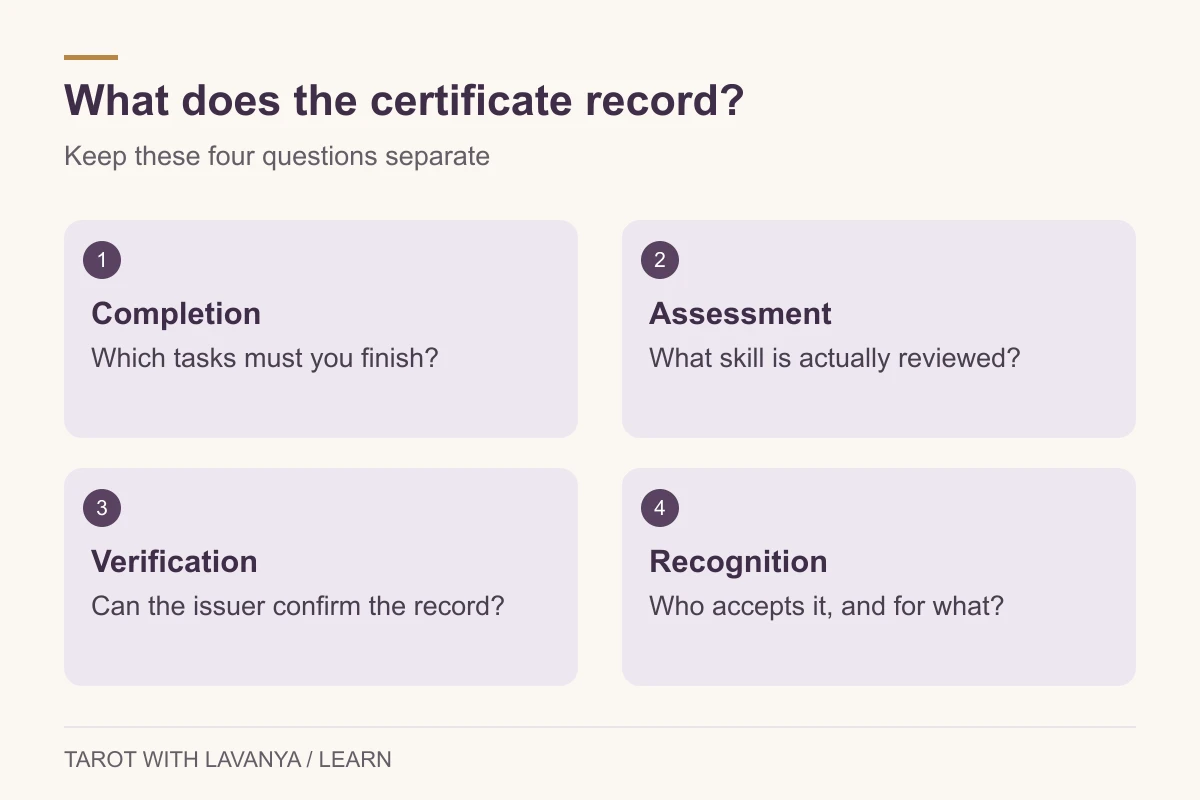
Certificate verification usually answers a narrow question: did this issuer issue this record to this learner? The process might use a document number, an issuer contact or a public verification page.
Recognition asks a different question: does a particular organisation accept that record for a particular purpose? You need an answer from the organisation that will make the decision.
A certificate can be genuine without satisfying an employer’s requirements. Likewise, a public lookup page does not establish government accreditation or professional licensing. Keep those claims separate when comparing providers.
If recognition matters to you, identify the intended use first. Ask the receiving organisation for its current requirements, then compare the course against them. Avoid paying for vague recognition that has no named practical purpose.
For Learn With Lavanya, the current certificate has no public verification URL. Do not describe it as independently verifiable through an online registry. Ask the course team about any document question you need resolved before enrolling.
How should you keep a record of your training?
Save the certificate alongside the course title, provider details, syllabus and completion requirements that applied when you studied. Keep a copy of any assessment feedback you are permitted to retain.
A separate practice portfolio can show the kinds of exercises you completed. Use fictional scenarios or material for which you have appropriate permission. Remove private information rather than treating a training portfolio as an exception to confidentiality.
For an image-reading example, compare the Fool and the Magician. Explain one difference in their imagery and how it could affect a response to the same practice question.
Label that work as a study exercise. It shows how you approach interpretation without claiming a client outcome. A reviewer can examine the reasoning rather than being asked to trust an impressive title.
Can you describe an unfinished course on your profile?
You can describe current study honestly, provided the wording does not imply completion. Name the course and say that it is in progress. Do not use a certificate title as an earned credential before meeting its requirements.
Once completed, use the document’s actual wording. For example, “Completed the Foundation Cohort; Certificate of Participation issued by Tarot With Lavanya” describes the record without inventing accreditation.
That wording is an example for someone who has actually completed the stated requirements. It is not a claim about the reader of this article. Add genuine supervised practice separately, using details you can substantiate.
Avoid suggesting that tarot training qualifies you to provide counselling, diagnosis or regulated advice. If you hold another professional qualification, describe its scope separately and accurately.
When is the course behind the certificate worth considering?
Return to the learning problem you want to solve. If you need a study sequence, look at the lessons. If you need feedback, examine the assignments and teacher access. If you need confidence speaking, ask about observed practice.
A programme can be useful even when its certificate is simply a participation record. Its value would come from what you learn and practise, not from pretending the document carries broader authority.
Conversely, an impressive certificate design cannot compensate for unclear teaching or missing feedback. Resolve those questions before comparing decorative seals, titles or promised prestige.
Ask yourself what would still make the course worthwhile if the certificate were removed. Your answer helps separate a learning purchase from a credential purchase. Both need clear evidence, but they solve different needs.
What questions belong in your final enquiry?
Ask for the exact certificate title, the issuer’s name and the requirements that apply to the batch you are considering. Confirm whether assessment, document delivery or replacement carries any separate charge.
If the page uses accreditation language, ask the provider to identify the specific body and programme record. Then verify the claimed relationship through that body’s own information. Do not rely only on an image of a logo.
Keep the response with the offer you buy. If your goal changes later, you will still have a clear record of what the programme promised. That is more useful than remembering a broad claim such as ‘globally accepted’.
A provider’s willingness to answer does not establish recognition by itself. The substance of the answer and its supporting evidence are what you need to assess.
A decision you can make this week
Write down why you want a certificate. If your answer is confidence, ask how the course provides feedback. If it is employment, verify the specific employer’s requirements first.
If your aim is learning to interpret and explain the cards, review the Foundation Cohort’s curriculum and assessment details. You can also practise with the one-card reading guide before deciding.
About Lavanya Arora
I am Lavanya Arora, a certified tarot reader and Chaldean numerologist based in Gurugram, Haryana. I have given over 4,000 paid sessions since 2019, hold 200+ verified five-star Google reviews, and was named Best Tarot Reader in India at the 2025 GHP Mental Health Awards.