
8 min read
The Short Answer:
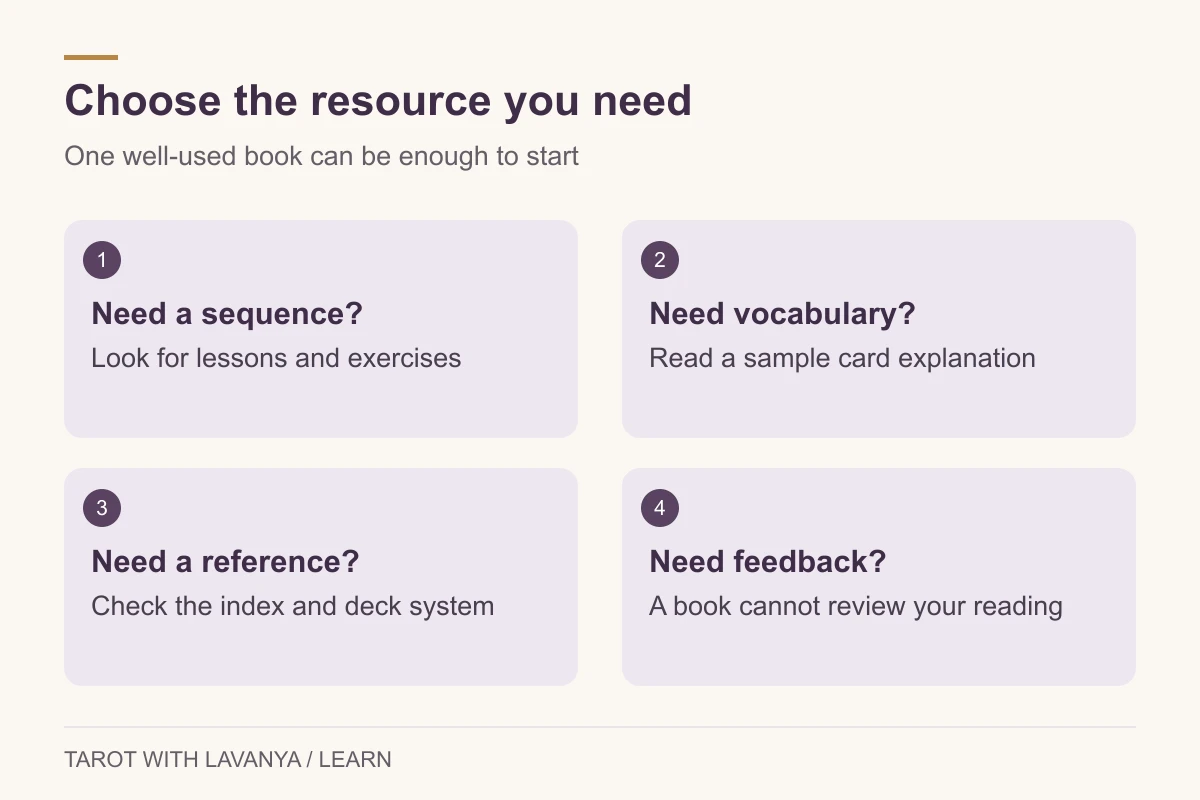
Different learners need different things from a tarot book. A structured lesson sequence works if you want someone to set the order. A reference suits you better once you already practise regularly. One book, used consistently, gets you further than four books gathered on a shelf.
A book can walk you through a tradition and hand you exercises to try. What it cannot do is prove that a reading predicts events, or confirm your interpretation fits every situation you will face.
This shortlist draws on publishers’ and authors’ own descriptions. No claim of personal testing sits behind every title here. There are no affiliate links, and you do not need to buy all four books.
Which book fits your current difficulty?
| Book | Author | Useful starting point if |
|---|---|---|
| Learning the Tarot | Joan Bunning | You want a sequence of lessons and card references |
| Kitchen Table Tarot | Melissa Cynova | You want an accessible introduction to decks, spreads and interpretation |
| The Ultimate Guide to Tarot | Liz Dean | You want an illustrated reference covering cards and spreads |
| The Ultimate Guide to Tarot Card Meanings | Brigit Esselmont | You want to compare detailed meanings while practising |
“Best” in this context means suited to a specific learning gap. No single author holds the only correct reading of the deck.
A structured starting point: Learning the Tarot
Nineteen lessons form the backbone of Joan Bunning’s book, with reference material for individual cards following after. The publisher’s description also lists card pairs and the process of forming a reading’s story within its scope.
This type of book helps most when your problem is figuring out what to study next. Work through one lesson, try its exercise, then move forward.
Age does not make the exercises irrelevant. Check the edition and preview first so you can judge whether the presentation and language suit you.
Your test for the week: explain one card pair in your own words. If you can only repeat the reference, go back to the pictures and the question.
A conversational introduction: Kitchen Table Tarot
Decks, spreads, meanings and symbols all get covered in Melissa Cynova’s Kitchen Table Tarot. The publisher describes a direct, conversational approach to the questions beginners actually ask.
Formal reference entries sometimes leave you unsure how a reading sounds out loud. If that is your problem, preview a section and see whether the author’s voice helps you understand.
And remember: a personal explanation is still an interpretation. You can learn from it without treating every statement as a rule all readers must follow.
Your test for the week: explain a card aloud using ordinary language. Cut any phrase you could not explain to someone who has never studied tarot.
An illustrated reference: The Ultimate Guide to Tarot
Illustrated card interpretations, reversals and several spreads appear in Liz Dean’s The Ultimate Guide to Tarot.
Wider symbolic correspondences and ritual practices get coverage too.
You can use the card and spread sections without adopting every ritual or metaphysical claim. This article does not recommend buying crystals, remedies or protective products.
A broad reference works best once you already have a practice routine and need somewhere to look things up.
Avoid turning each reading into a search through every possible meaning.
Your test for the week: choose one spread, define its positions and write your own answer before checking the reference.
A meanings reference: The Ultimate Guide to Tarot Card Meanings
Brigit Esselmont’s guide focuses on card meanings, upright and reversed interpretations included.
The author’s product page explains the available format and contents.
Check that page before ordering. Similarly titled tarot books are easy to confuse.
Esselmont’s guide and Liz Dean’s book are separate works by different authors, in particular.
After you have practised, a meanings reference lets you compare interpretations.
It becomes less useful if you keep searching until you find the answer you hoped for.
Your test for the week: record your interpretation first, then note one difference from the reference. Explain which detail or context led to that difference.
How do you choose between them?
Open a preview and read the explanation of one familiar card. What matters is whether you follow the reasoning, not just the vocabulary.
Match the book’s deck system to the cards you actually use. Compare the image in the book with your own deck. A different system may need a separate introduction.
Practical details matter too: print or digital format, edition, language, seller and delivery cost.
This guide does not promise Indian stock availability or quote a price that may change.
If your budget is tight, check a library or an authorised sample before buying.
An unfinished stack of books gives you less practice than one well-used reference.
How do you practise with a tarot book?
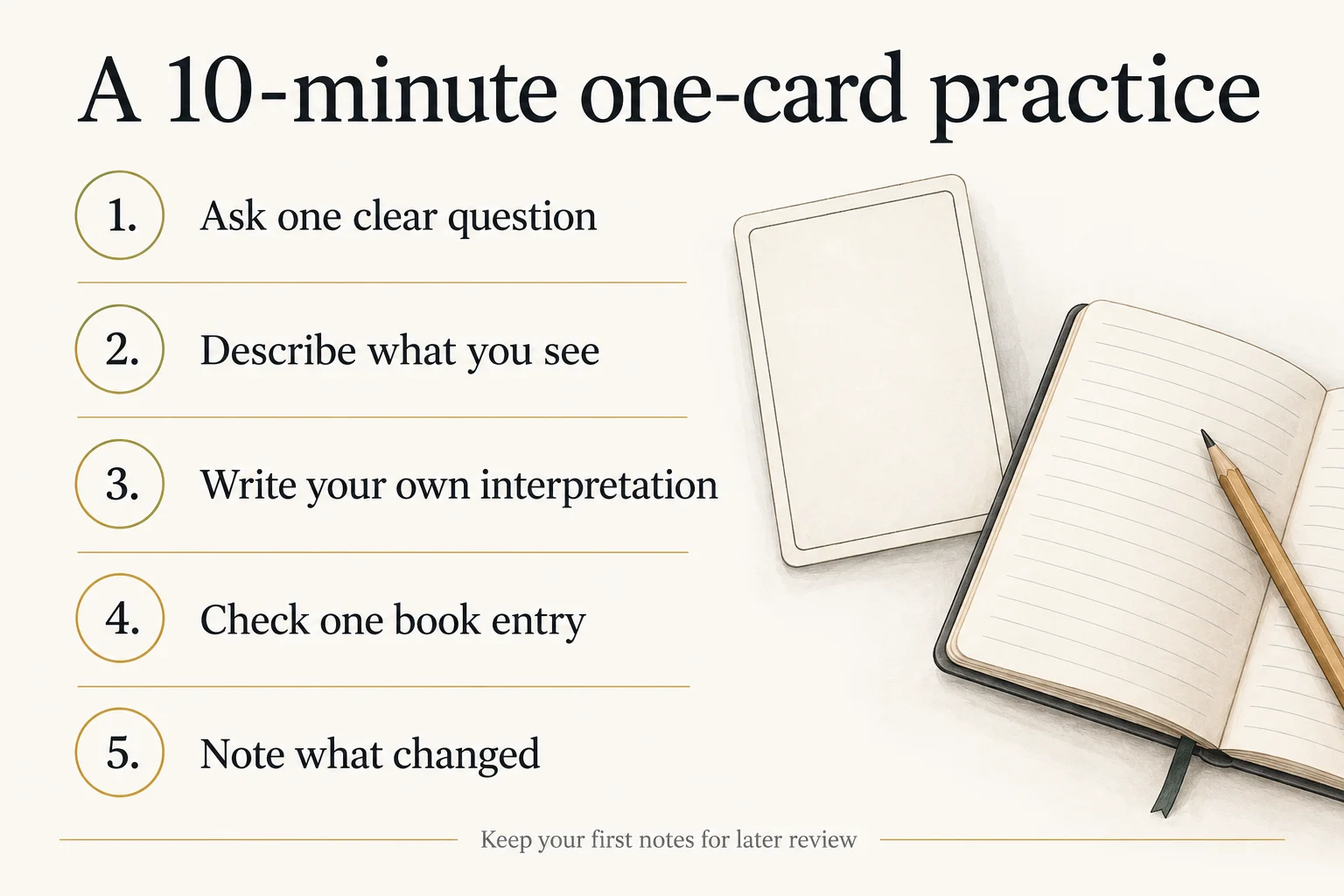
Write a clear question. Draw one card and describe the image. Offer a possible interpretation, then read the relevant entry in your book.
Record what changed after reading the reference.
Did it reveal a detail you missed, or did it merely give you more words for the same thought?
Finish with one question or action you can revisit later.
Keep the original entry intact so your later review does not quietly change what you first wrote.
For a worked starting point, use the one-card reading guide.
The question-framing guide helps when the card feels too vague to interpret.
Common questions about tarot books
Can you learn tarot from a book alone?
You can learn the structure and begin practising. A book cannot observe your reading or ask why you reached a conclusion. A practice partner or teacher can add that feedback.
Which book should you buy first?
Choose the one that addresses your current problem. If you do not know where to begin, a lesson sequence may help more than an extensive dictionary of meanings.
Why do books give different meanings?
Authors use different traditions, methods and contexts. Compare their reasoning. A difference does not require you to combine every interpretation into one answer.
Should you memorise the book’s definitions?
Learn the vocabulary, then practise applying it. If you cannot connect a definition to the question and image, repeating it more confidently will not resolve the gap.
What should you check in an authorised sample?
Read a short section that matches a task you want to learn. If connecting cards is your struggle, inspect a spread example. If basic vocabulary is what you need, look at a card entry and the introduction.
Notice whether the explanation points to visible details or only lists abstract associations. Could you explain the idea to another beginner without copying the author’s sentence? Ask yourself that.
Format matters as well. A small screen may make illustrated pages harder to use beside a deck. A searchable digital reference suits quick lookups, while a print book stays open more easily during study.
But do not assume a familiar title guarantees the edition or format you want. Confirm the author, publisher and contents against the official source before ordering. Similar titles are common enough to make this check worthwhile.
A short study session using one book
Set one task rather than an open-ended reading goal. Compare the Fool and the Magician, for example, then explain how their different images could change an answer about starting a project.
Look at your cards first. Write what you notice, then consult the book. Add one idea you learned and one question that remains. Keep the reference closed while writing your final explanation.
The Fool card guide and Magician card guide offer another pair of examples. Compare the reasoning without trying to merge every source into one definitive meaning.
At the end, decide what you need next. That might be another exercise, clarification from a teacher or more familiarity with the pictures. It need not be another book.
What if two authors disagree?
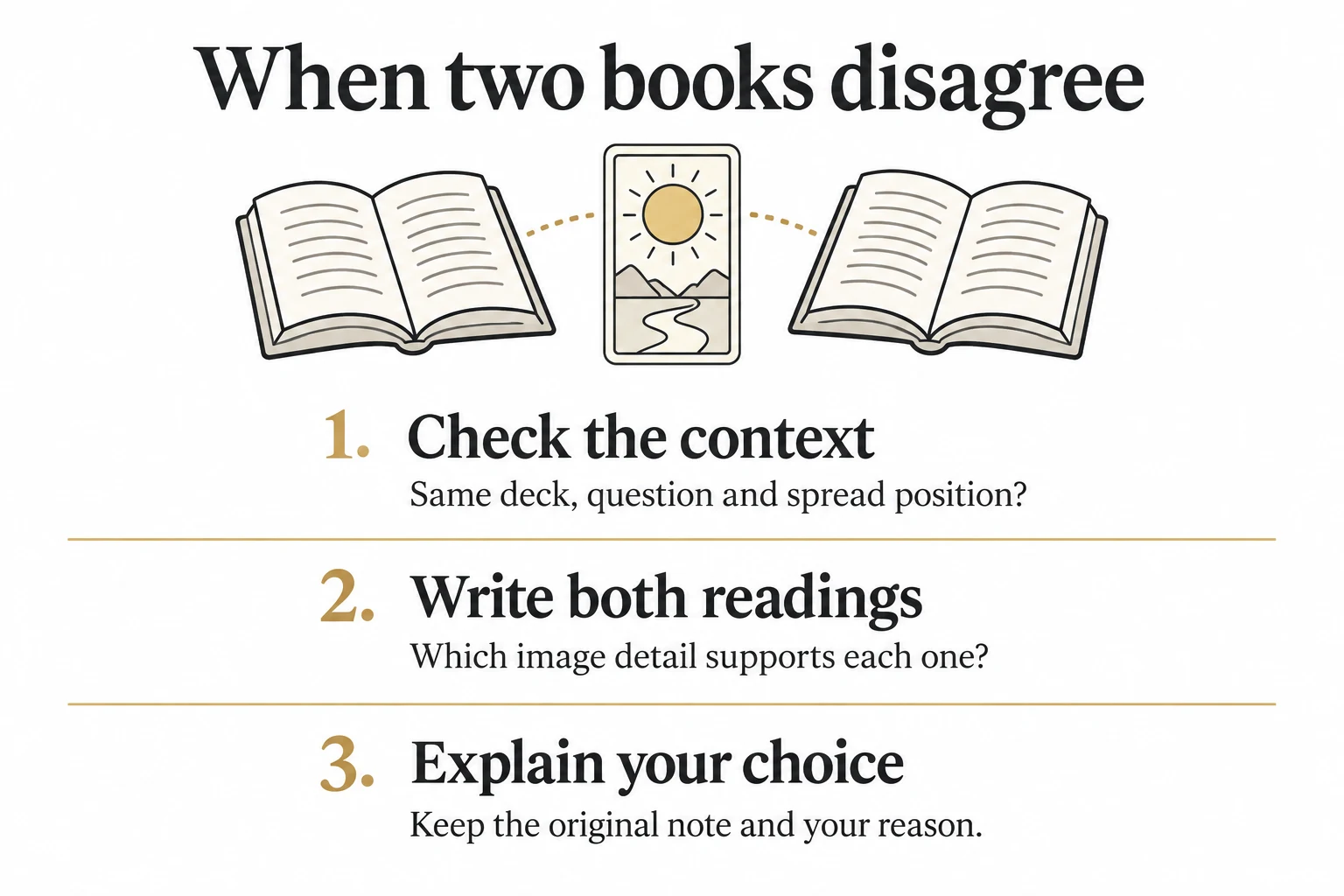
First check whether they are discussing the same deck tradition, spread position and question.
A general card entry and a contextual example may appear to disagree because they serve different purposes.
Write the two interpretations separately. Identify the visual detail or convention each one uses.
Then ask which is relevant to the question you are practising, while leaving room for uncertainty.
Avoid selecting whichever interpretation gives you the answer you wanted. That turns comparison into reassurance seeking.
Keep the original reading and note why you accepted or rejected an alternative.
A reading journal becomes more useful when it records decisions, not just quotations. You can revisit those decisions and see where your understanding changed without treating any author as infallible.
How can you tell when you need feedback instead of another reference?
If you understand individual entries but cannot form a clear answer, more definitions may increase the confusion. Try explaining one small spread aloud to a consenting practice partner.
Ask the partner to summarise what they understood. If their summary differs from your intended answer, review your wording and the connection between cards. A book cannot hear that conversation or respond to the gap.
Bring that specific difficulty to a teacher if you seek support. “I lose the thread between the second and third card” is easier to work on than “I need to know everything”.
When a book stops answering the question
This week, use one reference for three short readings. Keep a note of where you need feedback rather than buying another book immediately.
If connecting cards or explaining an answer is the difficulty, review the live course with supervised practice. The teaching format may matter more than adding another reference.
About Lavanya Arora
I am Lavanya Arora, a certified tarot reader and Chaldean numerologist based in Gurugram, Haryana. I have given over 4,000 paid sessions since 2019, hold 200+ verified five-star Google reviews, and was named Best Tarot Reader in India at the 2025 GHP Mental Health Awards.