9 min read · Updated Jul 29, 2026
The Emperor means structure, and whether yours is holding. Upright, it points to order, boundaries and somebody taking responsibility. Reversed, it points to control that has hardened, or structure that was never built in the first place.
The short answer. The Emperor is card IV of the Major Arcana. Upright it asks whether the framework around a decision is sound: the agreements, the limits, the person actually accountable. Reversed it marks either rigidity or absence. It describes how something is held together, not how it turns out.
What the Emperor cannot tell you
I would rather say this at the top than let you find it out three sections down.
The Emperor cannot tell you whether the person in charge is a good person. It cannot tell you whether your father, your boss or your husband will change. It cannot give you a date for anything, and I am not going to pretend otherwise.
What it does describe is the shape of the authority in a situation. Who sets the terms, who is holding the line, and whether that line is protecting anyone or just being enforced.
That is a smaller claim than a prediction. In my view it is also the more useful one, because structure is something you can renegotiate, and a forecast is something you can only wait for.
What does the Emperor mean?
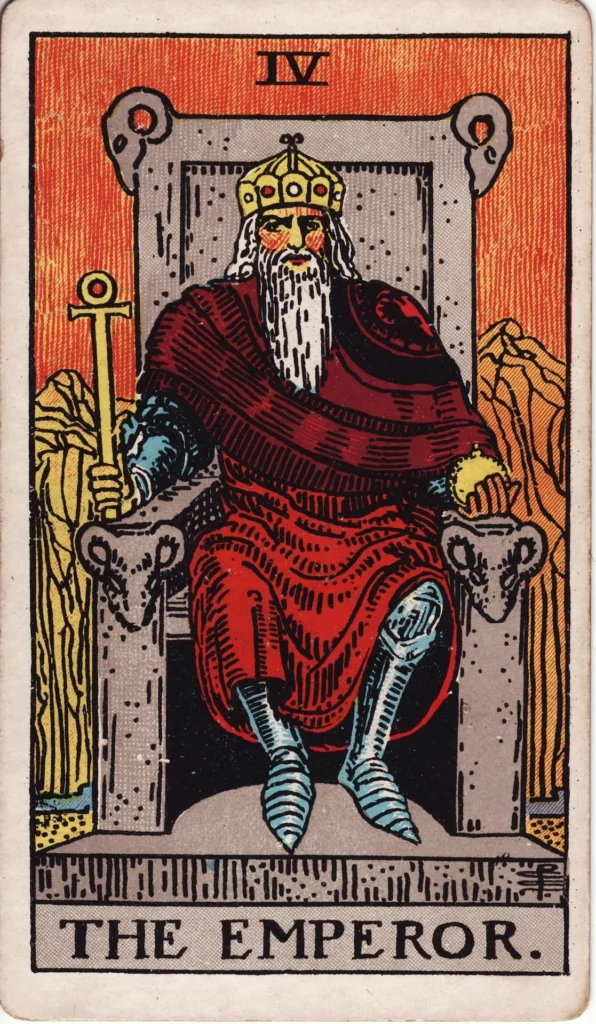
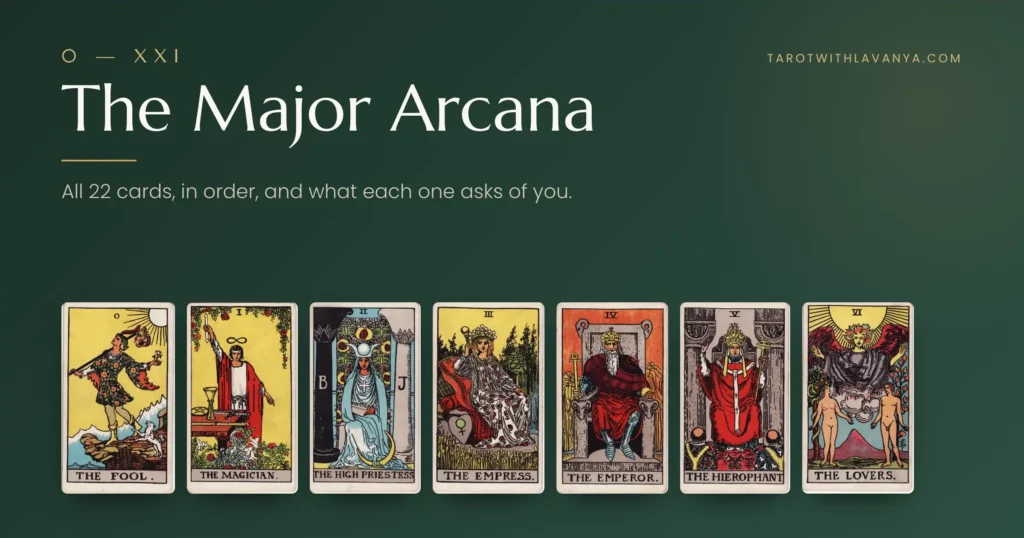
The Emperor is card IV of the Major Arcana, which places it directly after the Empress. That sequence is deliberate and I read a lot into it. The Empress grows things; the Emperor builds something to keep them in.
The picture is consistent across Rider-Waite-style decks. A figure sits on a stone throne carved with ram heads, wearing armour under a robe, holding an orb and a sceptre. Bare mountains rise behind him and there is very little green anywhere.
Every element points the same way. The armour under the robe says the authority is defensive rather than decorative. The stone throne says immovable, for better and for worse.
The bare mountains are the detail I would draw your attention to. Nothing soft grows in the picture, which is the honest cost of a life built entirely around order.
The ram heads tie the card to Aries and to Mars, and that connection is about initiative rather than aggression. The Emperor decides. Whether the decision is correct is a separate question the card does not answer.
If you want the primary source, A. E. Waite’s 1911 Pictorial Key to the Tarot is where these descriptions come from, and the card’s documented history covers the rest.
The Emperor upright: what it asks of you
Upright, I read the Emperor as one question. Who is actually responsible here?
Not who is loudest, and not who is most affected. Who has agreed to carry the outcome.
Most of the situations this card lands on are messy for a boring reason. Nobody ever said out loud who decides.
In love
Upright, the Emperor favours the explicit over the assumed, and I would say that is unromantic and correct.
Inside an existing relationship it usually points at an agreement nobody has made in words. Money, in-laws, whose career moves, who handles which parent. The affection is rarely the problem; the unstated terms are.
For a new relationship it can describe somebody steady, practical and slightly traditional. I would watch for one thing there. Steadiness and inflexibility look identical for the first three months.
The free daily love tarot reading will pull a card on one question if you want a prompt today. It is free and automated, and it is a prompt rather than a ruling.
This week: name one unspoken agreement out loud, and ask whether the other person agrees to it.
In career
Career is where I would expect this card most, and where it is usually easiest to act on.
Upright, it points to a role where the terms are clear. Clear brief, clear owner, clear measure of whether it worked.
If you want more responsibility, the card is unambiguous about the route. Become the person whose decisions hold up, then ask. In that order, because asking first is how good people get labelled ambitious rather than capable.
If you already lead, the upright Emperor is about protection rather than command. A framework that lets other people work without checking with you is worth more than the appearance of being needed.
The free daily career tarot reading gives you one card on one question, free, if today is the day.
This week: write down what you are accountable for in one sentence, and check that your manager would write the same one.
In money
Upright, the Emperor is the most boring card in the deck about money, and I mean that as a recommendation.
It points at rules you set once and stop renegotiating with yourself every month. Automatic transfers, a written limit, a plan somebody else has seen.
A card is not financial advice and I would not want it read as such. For debt, tax or investment, speak to a qualified financial adviser who can look at your actual position.
This week: automate one transfer so the decision stops needing willpower.
In health
Upright, the Emperor favours the scheduled over the inspired. The appointment in the calendar beats the intention held in the head.
It often points at the annual check nobody has booked. I would not read anything ominous into that. It is a card about maintenance, and maintenance is dull by design.
A reading is not medical advice and is not a substitute for a doctor. If something is wrong, have it assessed by a qualified professional. The free wellness tarot reading is free and automated if you want a prompt alongside that.
This week: book the appointment you have been carrying in your head since last year.
As someone’s feelings
When the Emperor describes how somebody feels about you, it reads as committed and considerably less expressive than it feels from the inside.
This is the card of the person who shows affection by fixing your car, handling the paperwork, and never once saying the sentence you want to hear. I would not read the silence as absence, though I would also not tell you to accept it forever.
This week: ask for the words directly rather than waiting to be surprised by them.
What does the Emperor reversed mean?
Reversed, the Emperor splits into two opposite failures, and separating them is the whole job.
The first is structure that has hardened into control. Rules kept after they stopped protecting anyone. Authority defending its own position rather than the people underneath it.
The second is structure that never existed. No agreements, no owner, everybody assuming somebody else has it handled. That version is quieter and I would argue it does more damage, because there is nobody to point at.
I want to be careful with the first version, because this card gets used to diagnose other people. The Emperor reversed applies to you at least as often as it applies to your boss or your father.
The cards sitting around it usually tell you which failure you are looking at.
In love, reversed
At the rigid end, this describes decisions made by one person and announced to the other. Money controlled, contact managed, disagreement treated as disloyalty.
At the absent end, it describes two adults avoiding every decision that matters, with the avoidance itself becoming the arrangement.
If control has become coercive, that is well past what a card can help with, and I would say so plainly. Speak to a qualified counsellor or a domestic support service rather than to a reader.
This week: write down which decisions you have not made in the last year, and who made them instead.
In career, reversed
Reversed, this is micromanagement, and it is also the leader who cannot delegate because delegation looks like disappearing.
It equally describes a workplace with no structure at all, where accountability moves to whoever complains least.
If you are on the receiving end, the practical answer is dull and it works. Write things down, date them, and stop relying on being remembered accurately.
This week: put one verbal agreement into an email, politely, and keep the reply.
In money, reversed
Reversed, I would look for one of two shapes. Either spending is being used to feel in control of something else, or somebody else holds the numbers and you have stopped asking.
Both are fixable, and both start with looking at the actual figures rather than the feeling about them.
Speak to a qualified adviser before restructuring anything, particularly if a family arrangement is involved.
This week: open the account you have been avoiding and read the balance out loud.
In health, reversed
Reversed, this is stubbornness dressed as strength. Advice ignored, rest treated as weakness, a body pushed to prove a point.
It can also describe stress from an environment where you have no say. That is a real cause of real symptoms and I would not have you talk yourself out of it.
If something has been going on for weeks, see a qualified professional rather than waiting for it to resolve itself.
This week: take the rest you have been describing as unearned.
As someone’s feelings, reversed
Feelings held behind a closed door, sometimes deliberately, sometimes because nobody ever taught this person how to open it.
I would read withheld warmth as fear more often than as strategy. That does not oblige you to wait indefinitely for it.
This week: say what you need once, clearly, and then watch what happens rather than explaining again.
Is the Emperor a yes or no card?
Upright, the Emperor leans yes, conditionally. Yes, if the structure is in place, and I would treat the condition as the important half.
Reversed it leans no, or not yet. Something in the arrangement is not sound enough to build on.
For a single yes-or-no question you can pull one now with the free yes/no tarot reading, which is free and automated. What it will not do is ask why the question needed asking, which is usually where the answer lives.
How the Emperor differs from the Empress and the Hierophant
Reading these three against each other makes each one sharper.
The Empress grows things and the Emperor contains them. She asks what needs feeding; he asks what needs a boundary.
The Hierophant, card V, is authority that comes from tradition rather than from a person. The Emperor decides; the Hierophant cites precedent.
Put plainly: the Empress nurtures, the Emperor decides, the Hierophant defers to what has always been done.
Reading the Emperor with the cards around it
One card is a fragment and the surrounding cards finish it.
With Pentacles nearby, I read the structure as financial or professional. With Cups, it is a family or relationship boundary rather than a work one.
Next to the Tower, look at whether the structure is being defended past the point where defending it makes sense.
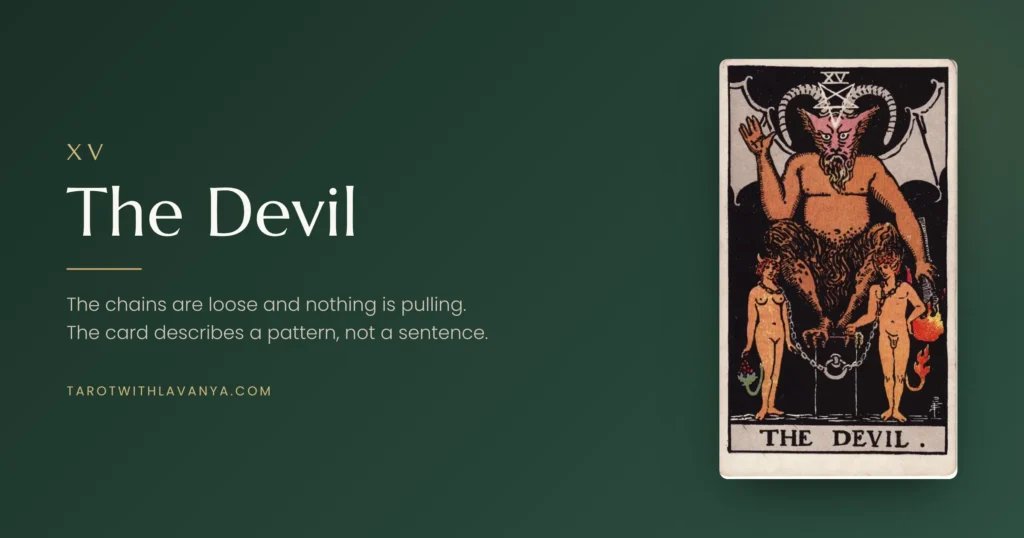
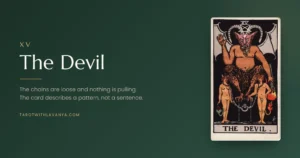
Next to the Devil, I would look hard at control, and at who benefits from the arrangement staying exactly as it is.
The Emperor cliff notes
| Attribute | Detail |
|---|---|
| Number | IV (four) |
| Astrology | Aries, ruled by Mars |
| Element | Fire |
| Upright keywords | Structure, accountability, boundaries, protection, decision |
| Reversed keywords | Rigidity, control, absent authority, unmade decisions |
| Yes or no | Upright: conditional yes. Reversed: not yet |
| Sits between | The Empress (III) and the Hierophant (V) |
What is in the picture
- Stone throne: immovable, for better and worse
- Ram heads: Aries, initiative, the decision made
- Armour under the robe: authority that expects to defend itself
- Orb and sceptre: reach, and the right to act
- Bare mountains: the honest cost of a life built only on order
What should you do this week if you drew the Emperor?
Pick the one situation where nobody has said out loud who decides, and say it out loud.
That is the entire instruction. Everything else this card offers is downstream of it.
If the answer is you, write down what you are accountable for and what you are not. If the answer is somebody else, write down what you have agreed to and what you never actually agreed to.
Then take one of those items to the person concerned this week. Not all of them, because all of them at once becomes a confrontation nobody planned.
Common questions about the Emperor
Frequently Asked Questions
Is the Emperor a good card to draw?
It is a structural card rather than a good or bad one. Upright it says the framework is sound or can be made sound. Reversed it says the framework is either too tight or missing. Neither is a verdict on the outcome.
Does the Emperor represent a specific person?
It can describe somebody who carries authority in your life, and traditionally that is read as an older or masculine-presenting figure. I would treat that loosely. The card describes a role far more reliably than it describes a body.
What does the Emperor reversed mean in love?
Either one person is making the decisions and announcing them, or nobody is making them at all. Look at which decisions have gone unmade in the last year, because that list is usually more honest than the feeling.
Can the Emperor tell me if I will get the promotion?
No. Tarot is weakest at outcomes and I would rather say that than sell you a yes. The card describes whether your responsibilities are clearly defined, which is a thing you can act on this week.
Is the Emperor about my father?
Sometimes, and I would not assume it. It points to the shape of authority in your life. For many people that is a parent, and for others it is a manager, a spouse, or a rule they set themselves years ago and never revisited.
Where to go next
If you are working through the deck, the tarot card meanings cluster covers the Major Arcana one card at a time.
If you would rather talk it through with somebody who has no stake in your answer, my reading packages list fixed prices. Nothing is urgent, and there is nothing to buy beyond the session itself.
Learn to read the whole deck
If you are working through the cards one at a time, that is how I teach them too. My live tarot course is a six-week, apply-only cohort covering all 78 cards, with the numerology layer sitting underneath each one, practice readings I give written feedback on, and a Foundation Reader certificate at the end. I teach it myself and I keep it small.
I am Lavanya Arora, a certified tarot reader and Chaldean numerologist based in Gurugram, Haryana. I have given over 4,000 paid sessions since 2019, hold 200+ verified five-star Google reviews, and was named Best Tarot Reader in India at the 2025 GHP Mental Health Awards.