7 min read · Updated Jul 29, 2026
The Chariot means holding one direction while two things pull against each other. Upright, it points to progress made through focus rather than force. Reversed, it points to effort without direction, or a direction you have stopped steering.
The short answer. The Chariot is card VII of the Major Arcana. Upright it describes forward movement that survives competing pressures, because you decided what matters and stayed with it. Reversed it describes scattered effort, stalling, or force applied where steering was needed. It describes how you are travelling, not where you land.
What the Chariot cannot tell you
I would rather deal with this at the top than let it sit underneath everything else you read here.
The Chariot cannot tell you that you will win. It is often described as a victory card and I think that framing does real damage, because it turns a card about effort into a card about outcome.
It also cannot give you a timeline. Not for the move, the case, the promotion or the recovery. Tarot is weakest at timing, and I would rather lose you at this paragraph than sell you a month.
What the card actually describes is your steering. Whether you have chosen a direction, and whether you are still holding it while two reasonable pressures pull in opposite ways.
That is a smaller claim than victory, and it is the one you can act on before Friday.
What does the Chariot mean?
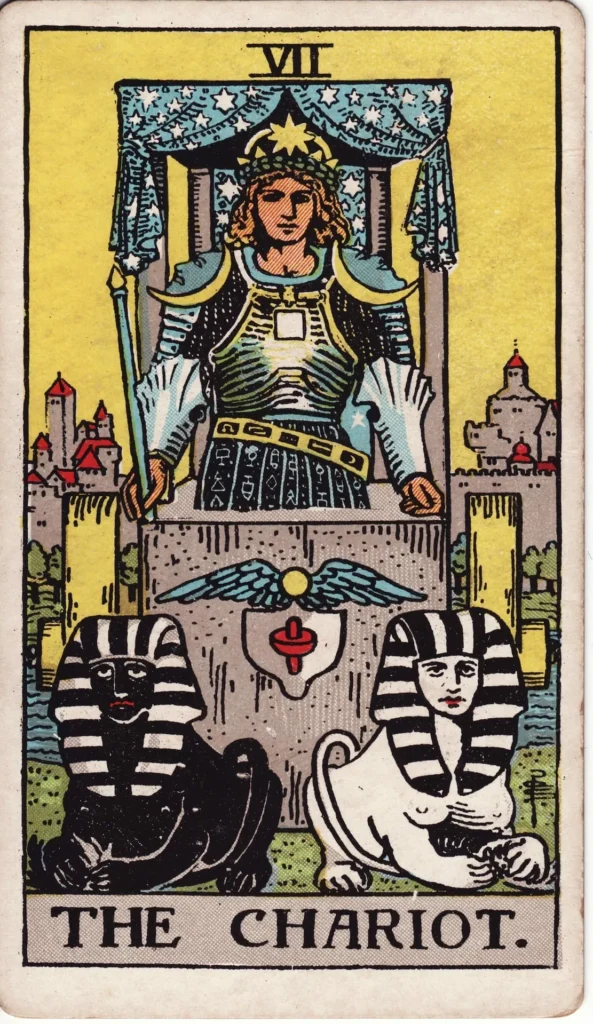
The Chariot is card VII of the Major Arcana, and its position in the sequence tells you a great deal. It follows the Lovers, which is the card of choosing. Once you have chosen, something has to carry the choice.
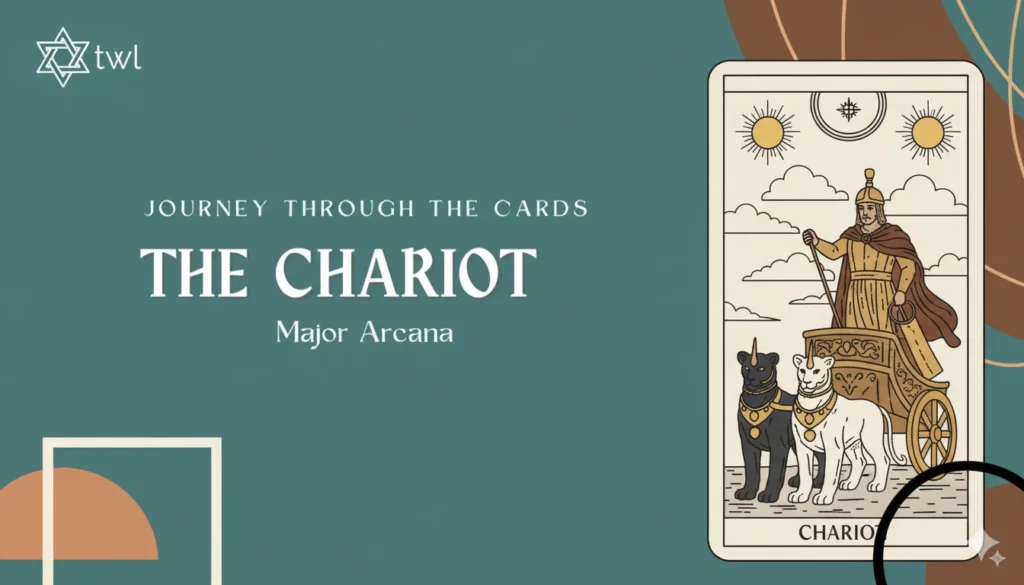
The picture is consistent across Rider-Waite-style decks. An armoured figure stands in a chariot drawn by two sphinxes, one black and one white. The sphinxes face slightly different ways. There are no reins in his hands.
Those missing reins are the detail I would build the whole reading on. He is not physically restraining anything. The chariot moves because he has decided where it goes, and the two opposing creatures have fallen in behind that decision.
The two sphinxes are not good and evil. I read them as two legitimate pulls: the part of you that wants to move and the part that wants to stay safe. Both of those are reasonable, which is exactly why the situation is hard.
A city sits behind him, meaning something familiar has been left. The canopy of stars overhead is usually read as a wider frame, and the square on his chest as a plain, grounded footing.
If you want the primary source, A. E. Waite’s 1911 Pictorial Key to the Tarot is where these descriptions come from, and the card’s documented history fills in the rest. For a longer modern treatment, Rachel Pollack’s Seventy-Eight Degrees of Wisdom is the standard reference and worth owning if you are learning.
The Chariot upright: what it asks of you
Upright, I read the Chariot as one question, and it is not a comfortable one. What have you actually decided?
Not what you prefer. Not what you are hoping resolves itself. What you have decided, in a way that survives a bad week.
I take the card as assuming both pressures are real. It does not ask you to make one of them go away. It asks which one is driving.
In love
Upright, the Chariot favours the person who knows what they want and can say it without turning it into an ultimatum.
Inside an existing relationship it usually appears when two people are pulling toward different lives and both are being reasonable about it. City versus hometown, career versus family timing, one person’s parents versus the other’s.
I would not read the card as picking a side. It says the conversation has been postponed and the postponement is now the problem.
If you are single, it points to knowing what you are actually looking for. The free daily love tarot reading gives you one card on one question, free and automated, which is a prompt rather than a ruling.
This week: say the decision out loud, once, without softening it into a question.
In career
Career is where I read this card as clearest, and it is usually less about ambition than people assume.
Upright, it describes somebody carrying a direction through resistance. Not a dramatic resistance. Meetings that go nowhere, a manager who never quite says no, a project that is neither approved nor cancelled.
I read the card as favouring narrowing. Two live priorities are workable and five are not. If you feel stuck, count yours.
If you are steering something new, this is the card of month four rather than month one. The excitement has gone and the work has not.
The free daily career tarot reading will pull one card on one question if today is the day to look at it.
This week: drop or pause one of your current priorities, properly, and tell whoever needs to know.
In money
Upright, the Chariot points at money decisions that need one clear direction rather than several hedged ones.
The pattern I would look for is capital spread thin across four half-commitments, none of which are given enough to work.
A card is not financial advice and I would not want it treated as such. Before consolidating, borrowing or investing, speak to a qualified financial adviser who can see your real position.
This week: list every financial commitment you are half-in on, and decide which one gets your attention first.
In health
Upright, I read the Chariot as favouring consistency over intensity, and it is unusually direct about pacing.
The classic shape here is somebody doing a great deal for three weeks and nothing for the next six. The card is not against effort. My reading is that it is against effort with no throttle.
A reading is not medical advice and is not a substitute for a doctor. If something is wrong, have it assessed by a qualified professional. The free wellness tarot reading is free and automated if you want a prompt alongside that.
This week: cut your plan in half and hold the smaller version for the full seven days.
As someone’s feelings
When the Chariot describes how somebody feels about you, it reads as decided and contained. They know, and they are not necessarily showing it yet.
I would take this as a card of intent rather than expression. The feeling has direction. The communication has not caught up.
This week: ask a direct question rather than reading the silence for signals.
What does the Chariot reversed mean?
Reversed, the Chariot describes movement without steering, and it takes several recognisable shapes.
The commonest is effort in every direction at once. Long hours, real exhaustion, and no discernible progress, because nothing was ever prioritised over anything else.
The second is force applied where steering was needed. Pushing harder at a person or a process that was never going to respond to pressure.
The third is the quiet one, which is stopping altogether. The chariot parked, the decision permanently deferred, and the delay reframed as patience.
I would not treat any of these as a failure of willpower, and I want to be firm about that. Reversed, I read this card as meaning the direction was never chosen, so there was nothing to steer toward.
In love, reversed
At the forcing end, this is pushing for a definition the other person is not ready to give, and reading their hesitation as something to overcome.
At the stalled end, it is a relationship carried for years without either person deciding anything about it.
Both are avoidance. One is loud and one is quiet, and I would say the quiet one costs more because it costs years.
This week: name the decision that has been open longest, and put a date on making it.
In career, reversed
Reversed, this is the card of the very busy, and busy is doing a lot of work in that sentence.
It describes constant motion with no direction, and it very often describes somebody who is afraid that stopping to choose will look like a lack of commitment.
It can also describe burnout wearing the mask of drive. If you cannot remember the last week you finished something, that is the reading rather than the schedule.
This week: write your top three priorities, then delete the third one.
In money, reversed
Reversed, I look for money moving fast without a plan underneath it. Several strategies started and none evaluated.
Slow down and count what you already have running before you add anything to it.
Speak to a qualified financial adviser before consolidating or committing, especially under time pressure from anyone.
This week: write down every recurring payment you have, and cancel the one you had forgotten existed.
In health, reversed
Reversed, this is the all-or-nothing cycle, and pushing through a body that has already asked twice.
I would read repeated small injuries and repeated small illnesses as the card speaking plainly. That is a pacing signal rather than a character flaw.
If something recurs, see a qualified professional instead of adjusting the routine again.
This week: take the full rest day without negotiating with yourself about it.
As someone’s feelings, reversed
Feelings pulling in two directions at once, and a person who has not resolved them internally.
I would not read that as dishonesty. Unresolved is a real state and people do sit in it for a long time. It does become your problem when it stops moving.
This week: ask where they stand, and treat a non-answer as an answer.
Is the Chariot a yes or no card?
Upright, the Chariot leans yes, and the yes is conditional on you steering. Yes, if you hold the direction rather than hoping it holds itself.
Reversed it leans no, and more precisely, not while it is being handled this way.
For a single yes-or-no question you can pull one now with the free yes/no tarot reading, which is free and automated. It cannot ask you the follow-up question, and the follow-up is usually where the real answer is.
How the Chariot differs from the Fool and the Magician
Reading these three against each other is the fastest way to get all three right.
The Fool begins without knowing how. The Magician begins knowing exactly how. The Chariot is neither, because it is about what happens long after the beginning.
The Fool is mile zero and the Magician is the moment of starting. The Chariot is mile fifty, when nothing is new and the decision has to be made again anyway.
Put plainly: the Fool jumps, the Magician builds, the Chariot steers.
Reading the Chariot with the cards around it
A single card is a fragment and the cards beside it complete it.
With Wands nearby, I read the two pulls as ambition against ambition. With Cups, the conflict is emotional and usually involves other people’s needs.
Next to the Eight of Cups, look at whether the direction being held is one you still want or one you are simply committed to.
Next to the Devil or the Ten of Wands, I would read it as force where steering was needed, and the card is asking you to stop pushing.
The Chariot cliff notes
| Attribute | Detail |
|---|---|
| Number | VII (seven) |
| Astrology | Cancer |
| Element | Water |
| Upright keywords | Direction, focus, momentum, self-command, holding a line |
| Reversed keywords | Scattered effort, force, stalling, no chosen direction |
| Yes or no | Upright: yes, if you steer. Reversed: not while handled this way |
| Sits between | The Lovers (VI) and Strength (VIII) |
What is in the picture
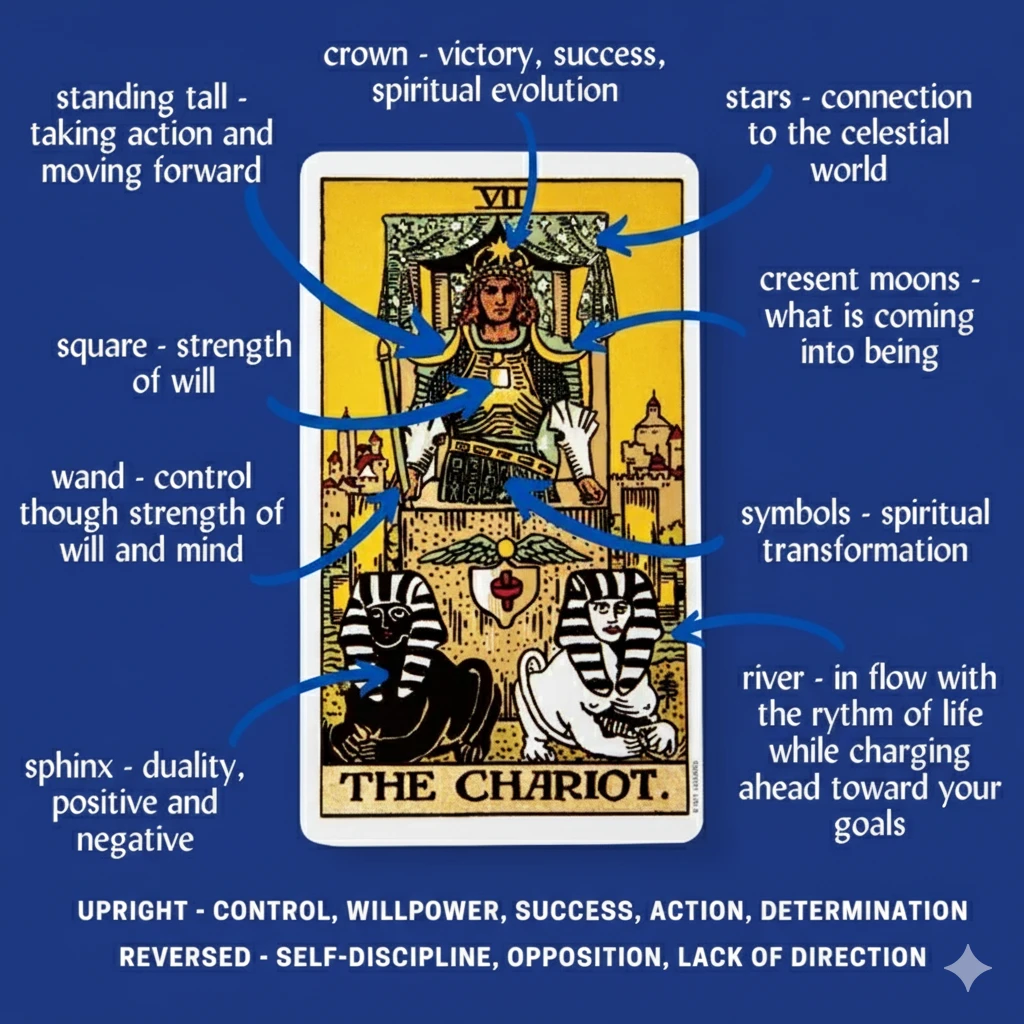
- Two sphinxes: two legitimate pulls, not good against evil
- No reins: direction held by decision, not by restraint
- Armour: readiness rather than aggression
- City behind: something familiar already left
- Square on the chest: a plain, grounded footing
- Canopy of stars: the wider frame the journey sits inside
What should you do this week if you drew the Chariot?
Name the two things pulling against each other, in one sentence each, and then decide which one is driving for the next thirty days.
Not forever. Thirty days is short enough to commit to and long enough to show you something.
Write the losing priority down somewhere you can see it, because the point is not to pretend it stopped mattering. The point is that it is not steering right now.
At the end of the thirty days, look again. If the direction still holds, extend it. If it does not, you have learned something a longer wait would not have taught you.
Common questions about the Chariot
Frequently Asked Questions
Is the Chariot a victory card?
It is described that way and I would push back on it. The Chariot describes effort held in one direction, which often precedes a good result and never promises one. Treating it as a victory card sets people up to stop steering.
What does the Chariot reversed mean?
Effort without direction, force where steering was needed, or a full stop that has been renamed patience. Look at which of the three matches your last month rather than picking the flattering one.
Is the Chariot a yes or no card?
Upright it leans yes on the condition that you keep steering. Reversed it leans no, or not while the situation is being handled this way.
Does the Chariot mean I will get what I want?
No card carries that information. The Chariot describes whether you have chosen a direction and whether you are holding it. Those are the parts within reach, which is why I would rather talk about them.
Why is the Chariot linked to Cancer?
Traditionally the card is assigned to Cancer, the sign associated with carrying home along with you. I read that as the useful part of the card: you can travel a long way without abandoning what anchors you.
Where to go next
If you are working through the deck, the tarot card meanings cluster covers the Major Arcana one card at a time.
If you would rather talk it through with somebody who has no stake in your answer, my reading packages list fixed prices. Nothing about it is urgent, and there is nothing to buy beyond the session.
Learn to read the whole deck
If you are working through the cards one at a time, that is how I teach them too. My live tarot course is a six-week, apply-only cohort covering all 78 cards, with the numerology layer sitting underneath each one, practice readings I give written feedback on, and a Foundation Reader certificate at the end. I teach it myself and I keep it small.
I am Lavanya Arora, a certified tarot reader and Chaldean numerologist based in Gurugram, Haryana. I have given over 4,000 paid sessions since 2019, hold 200+ verified five-star Google reviews, and was named Best Tarot Reader in India at the 2025 GHP Mental Health Awards.